Ruger Mark IV Review: The Complete Mk IV 22/45 Guide
What makes the Ruger Mark IV the best in a long line of American-made autoloading rimfire pistols? We ran nearly 2,000 rounds to find out.

Written By
Michael Crites
Licensed Concealed Carry Holder
Reviewed by
Editorial Team
Learn About The Editorial Team
Share:
Products are selected by our editors. We may earn a commission on purchases from a link. How we select gear.
Updated
Jul 2026
Ruger kicked off its past 75 years with a humble little .22 LR semi-automatic pistol that Bill Ruger himself crafted in a garage workshop. Now in its fourth and cleanest iteration, the current Mark IV brings with it a one-button takedown process that revolutionizes its maintenance. All the complexity users had to overcome on past models has been replaced by a simple press of a button on the rear of the frame, and the pistol disassembles in seconds.
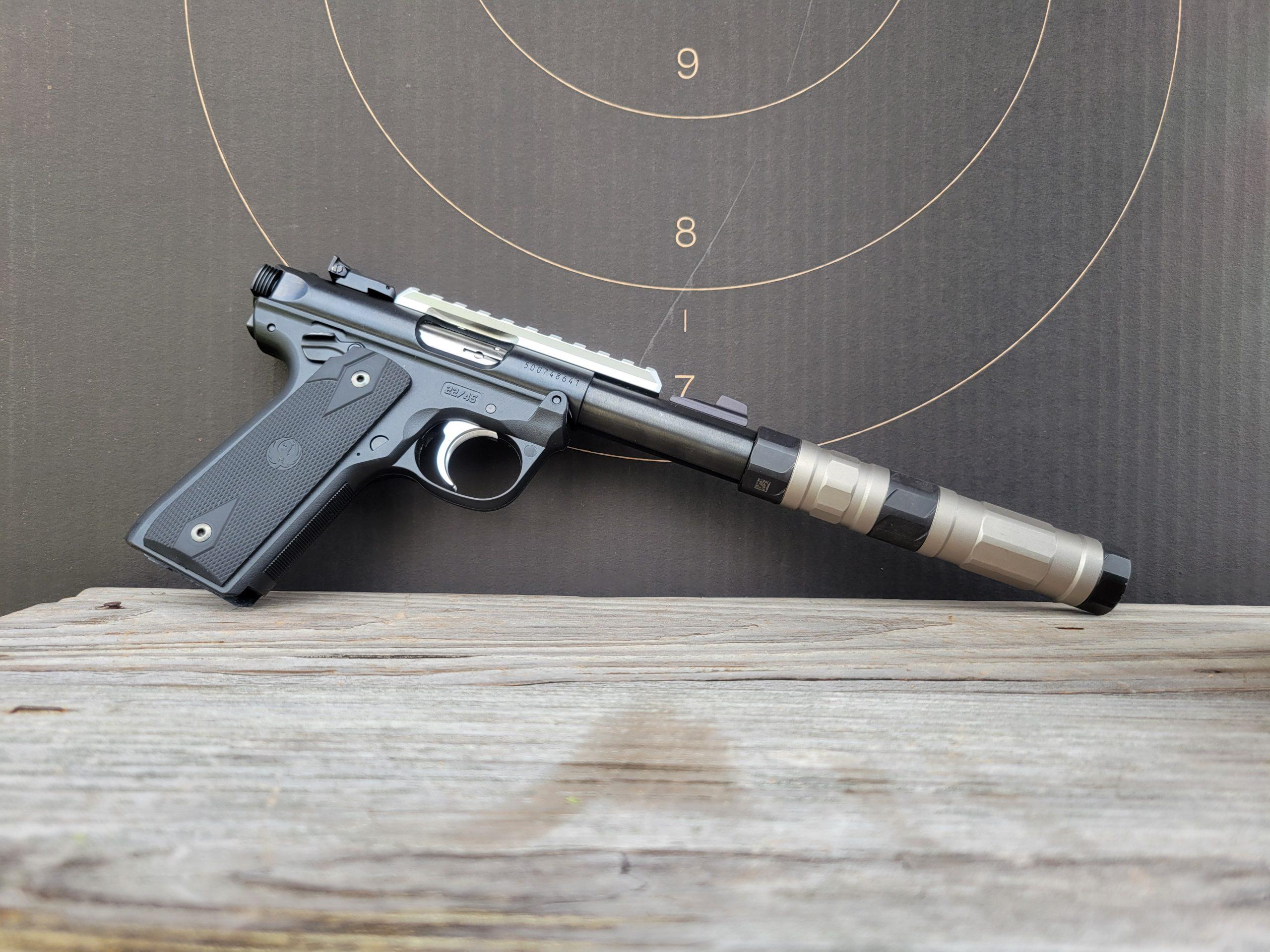
In this piece, we cover the whole Mark IV ecosystem including the Standard, Target, Hunter, Competition, 22/45, 22/45 Lite, 22/45 Tactical, and the Silencer Shop SSH, with special emphasis on the 22/45 in its 4.4-inch threaded bull barrel format, complete with range-tested accuracy data, a measured trigger pull, and a structured variant comparison table. Readers looking to have a question answered will find them here.
Throughout testing on our evaluation 22/45, we ran just shy of 2,000 rounds through our handy little pistol, including bulk pack Federal and Winchester. We also shot several different 100-round boxes of more specialty CCI ammo subsonics and hollow-points billed for varmint hunting.
We’ll cover the Mark IV’s history, variants, optics and suppressor use, range data, maintenance, upgrades, and give you a final recommendation based on the results of our testing.
In This Article
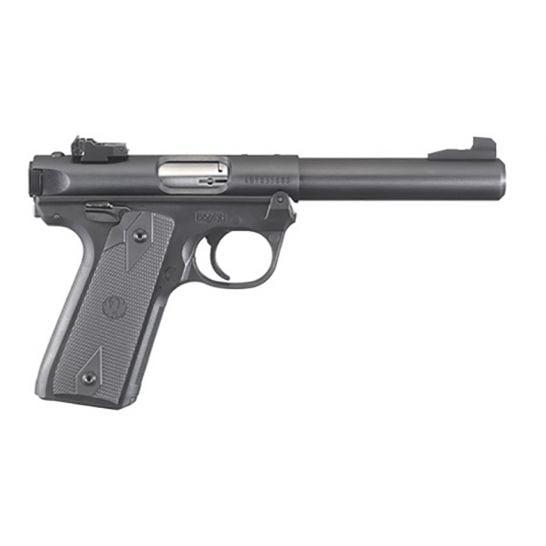
The Ruger Mark IV



Pros
One-button field strip removes the only legitimate complaint that plagued three generations of Mark series owners. Cleaning is no longer a special event.
Cold hammer-forged barrel delivers consistent accuracy — 1-inch groups at 25 yards from a bench rest are achievable with quality ammo on the Target model.
Deep aftermarket: TandemKross and Volquartsen alone provide enough upgrade options to turn a stock Mark IV into a competitive gun without breaking the bank.
The 22/45 grip angle is a genuine training advantage for 1911 and 2011 shooters; mild recoil makes it equally effective for introducing new shooters to semi-auto pistols.
Factory suppressor-ready options — Tactical, SSH, and Threaded Bull variants — cover the rimfire can market without requiring warranty-voiding gunsmith work.
Considerations
Trigger reset is long across all models. Competitive shooters transitioning from striker-fired guns or a 1911 will need to consciously adjust their technique and dedicate range time to it.
The magazine disconnect safety prevents the pistol from firing without a fully-seated magazine. Experienced shooters find it irritating, and it is not removable without aftermarket parts.
Reliability is ammo-sensitive. Low-powered or bulk-pack loads produce failures to extract at a higher rate, particularly with full 10-round magazines. Winchester bulk pack, in our testing, was a consistent source of malfunctions across almost every magazine loaded.
Aftermarket uppers are serialized parts requiring FFL transfer — an unexpected cost that buyers routinely discover only after ordering.
The SSH is optic-dependent from the first round. No iron sights means no fallback when the battery dies or the optic fails at the wrong moment.
Our Verdict
There are three distinct buyers for the Mark IV family, and none of them should be confused with the others.
For the rimfire enthusiast who wants the most capable and maintainable .22 LR pistol under $500, the Mark IV 22/45 or Target is the answer, full stop. For the suppressor owner who wants a purpose-built host without warranty concerns, the 22/45 Tactical covers the full-size need and the SSH solves the OAL problem. For the 1911 or 2011 shooter looking for a low-cost training companion, the 22/45’s grip angle is the entire argument — no other rimfire pistol replicates that manual-of-arms as cleanly.
The Mark IV is not the cheapest rimfire pistol on the market. It is the most fully realized. The one-button takedown solved the only problem that actually plagued the Mark series for four decades. What remains is a cold hammer-forged, accurate, and deeply upgradeable pistol that earns its place in any collection for reasons that compound over time.
After 75 years and four major iterations, Ruger’s Mark series has finally become as easy to own as it has always been to shoot.
Specs
Caliber: | 22 LR |
Action | Semi-automatic blowback-operated |
Barrel Length | 4.4 in. (threaded bull barrel primary review configuration) |
Thread Pitch | 1/2×28 TPI |
Overall Length | 9.75 in. |
Weight (unloaded) | 33 oz. (Tactical configuration) |
Frame Material | Glass-filled polymer |
Grip Angle | 18 degrees (1911-pattern) |
Magazine Capacity | 10 rounds |
Trigger Pull | 3.8 lbs. avg. (measured stock configuration — see range section) |
Sights | Adjustable rear; fixed blade front (fiber optic upgrade available) |
MSRP | $499–$620 (22/45 Tactical); $325–$499 (22/45 standard) |
Ruger Mark History and Evolution
After spending part of his youth designing guns for the military during World War II, 33-year-old Bill Ruger — backed by his friend Alex Sturm — introduced the original Ruger Standard Model in 1949. The form factor owed a direct debt to the Swiss/German Luger and the Japanese Type 14 Nambu: a swept-back 55-degree grip, a fixed barrel, and a tubular receiver that looked unlike anything else American-made at the time. That aesthetic template still governs the Standard, Target, Hunter, and Competition variants of the Mark IV today.
The road from 1949 to 2016 followed a straight if incremental line. The original Standard was renamed the Mark I after Alex Sturm’s death. The Mark II arrived in 1982 with an improved bolt stop and magazine release. The Mark III in 2005 relocated the mag release, added a loaded chamber indicator, and introduced a magazine disconnect safety — all useful features, all buried inside a disassembly process that became legendary for exactly the wrong reasons.
The Mk III’s field strip sequence earned the kind of notoriety most companies spend fortunes trying to avoid. TTAG described it as requiring “a mechanical engineering degree, a series of complicated intricate three-handed maneuvers, the help of multiple YouTube videos, and a rabbit’s foot.” Outdoor Life’s John Snow compared reassembly to initiating a nuclear strike. I have never found a soul who documented something positive about the Mark III takedown procedure.
The Mark IV fixed it. One button. The rest is history — specifically, the history of every Mk III owner never having to curse at a cleaning bench again.
The striker-fired Glock pattern gun uses a clean trigger, set to break between 4.5 and 5 pounds, and it’s remarkably consistent. I ran it through my trigger scale probably 30 times and each time got exactly 4.5 lbs. Plus, it weighs only 23 ounces makes it easily portable and comfortable to shoot.
While the DR920 and DR920P models do not come with a reduced power recoil spring, this is intentional to enhance recoil management and overall performance during shooting.
It also comes with an incredible grip finish texture, as well as many slide windows to allow better traction and manipulation of the pistol in action.
The stainless steel slide comes pre-cut from the factory for optical sight options, most of which require little to no adaptation to fit with the provided spacers. So you can install your favorite red dot on this pistol, likely with nothing more than screws.
Mk IV Models — Target, 22/45, and Variants
| Model | Barrel | Profile | Sights | Rail | ~Price | Notes |
|---|---|---|---|---|---|---|
Mark IV Standard | 4.75" or 6" | Tapered | Fixed | No | ~$299–$349 | Classic lines; no Picatinny rail; good entry price |
Mark IV Target | 5.5" (bull) | Bull | Adj. target | Some | ~$450–$530 | Most popular variant; threaded option adds suppressor path |
Mark IV Hunter | 6.88" (fluted) | Fluted | Fiber-optic adj. | No | ~$699 | Stainless; varmint-oriented; weight-forward balance |
Mark IV Competition | 6.88" (slab) | Slab-side | Adj. target | No | ~$699 | Match-grade sights; slab barrel for bench shooters |
Mark IV 22/45 | 4.4" (bull or std) | Varies | Adj. or fixed | Varies | ~$325–$499 | 1911 grip angle; broadest variant family; primary review subject |
Mark IV 22/45 Lite | 4.4" | Alloy sleeve | Adj. | Yes | ~$499–$549 | Lightweight alloy upper; multiple anodize colors; Steel Challenge staple |
Mark IV 22/45 Tactical | 4.4" threaded | Bull | Adj. | Yes | ~$550–$620 | Threaded muzzle (1/2x28); Picatinny rail; suppressor-ready |
Mark IV SSH | 3" threaded | Compact | None | Yes | ~$559 (SSH direct) | No iron sights; optic-only; shortest OAL; Silencer Shop exclusive |
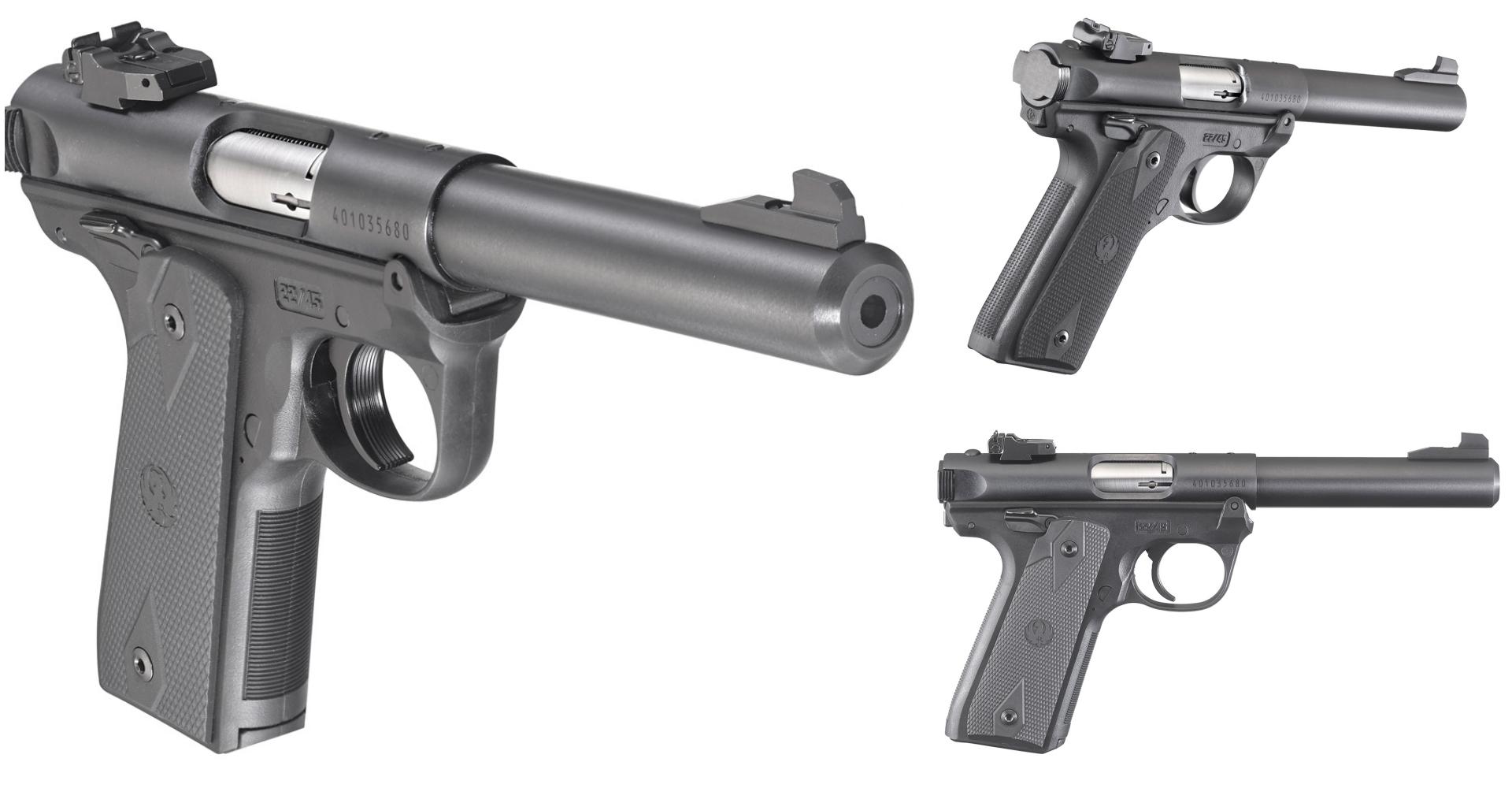
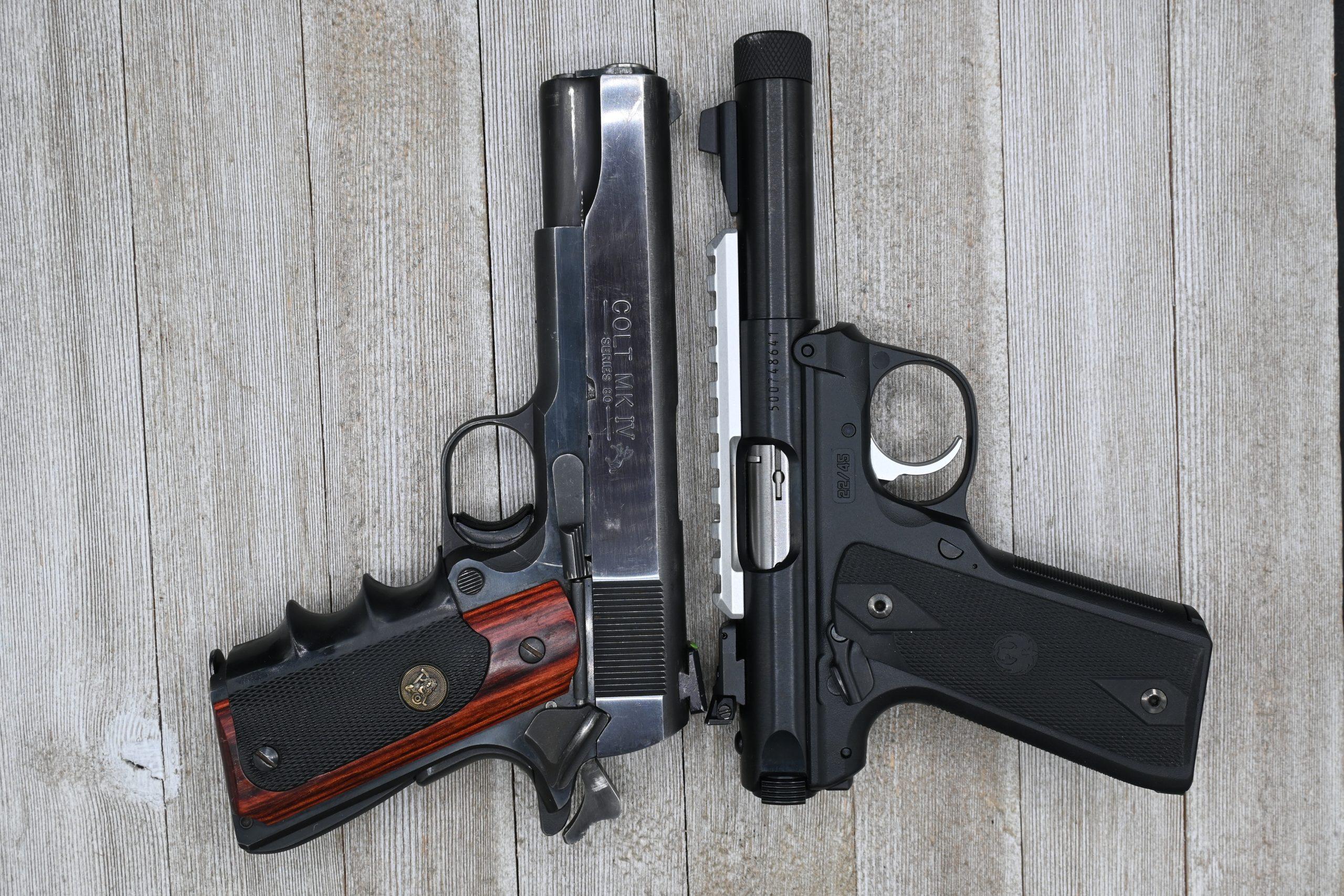
The Mark IV Standard, Hunter, and Competition retain the traditional swept-back grip geometry inherited from that original Nambu/Luger-influenced design. Meanwhile, the 22/45 sub-family — 22/45, 22/45 Lite, 22/45 Tactical, and SSH — uses a polymer frame with an 18-degree grip angle that mirrors the 1911-pattern GI .45.
For shooters who train primarily with a 1911 or a 2011-pattern pistol, the 22/45 is a natural drill companion at rimfire cost. One practical caveat: the grip angle difference makes 22/45 magazines unique to that sub-family. They will not interchange with standard Mk IV mags, so order spares accordingly.
The Mark IV Target’s 5.5-inch bull barrel adds mass up front, improving balance for bench and precision work while enabling the threaded muzzle option on most current production units. The Hunter stretches to 6.88 inches of fluted stainless steel for field applications.
Both retain adjustable iron sights — the rear sight is fully adjustable for windage and elevation, which combined with the front sight delivers a sight picture that works for both competitive shooters grinding splits and casual range visitors learning the platform.
The Tactical and SSH exist for suppressor users. The Tactical runs the standard 4.4-inch threaded barrel at 1/2×28 with a full Picatinny rail and still ships with serviceable adjustable sights installed — a detail that matters when you’re shooting it without a can.
The 22/45 Tactical weighs approximately 33 ounces, which keeps muzzle flip manageable and contributes to the flat-tracking behavior that makes extended strings pleasant to run. The SSH trims barrel length to 3 inches, removes the iron sights entirely, and goes optic-only by design.
Which model is right for you? Shooters who already own a 1911, 2011, or any pistol sharing that grip angle should evaluate the 22/45 family first. Those who want a precision bench gun should go straight to the Target. Suppressor owners who want a purpose-built host without aftermarket modification should buy the Tactical or SSH and skip the rest of the conversation.
Grip, Ergonomics, and Controls
The Mark IV’s slim grip profile is one of the pistol’s genuine ergonomic strengths. The grip is narrow enough to sit naturally in a shooter’s hand — particularly for those with smaller hands — without feeling cramped for larger ones.
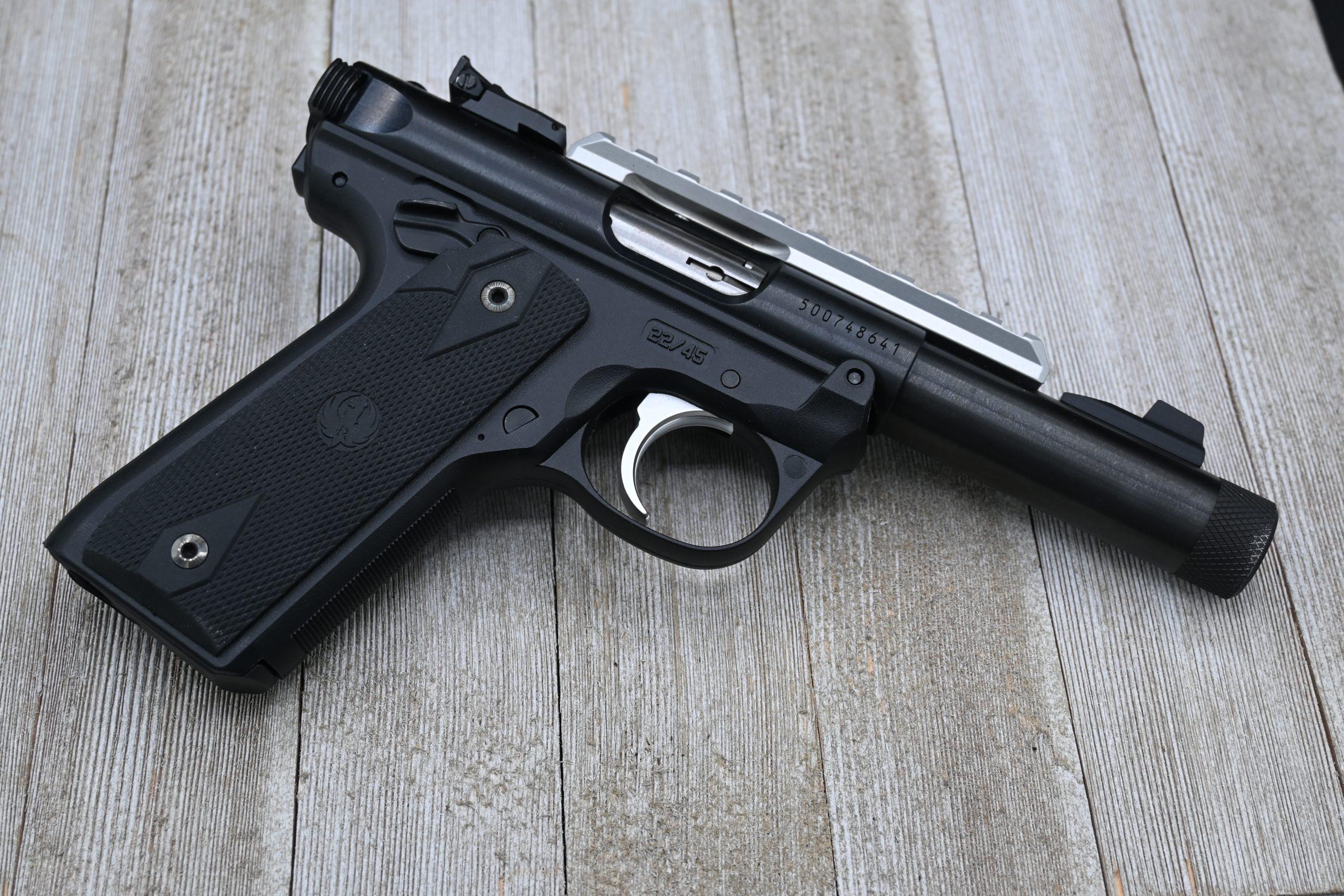
On the 22/45, the polymer frame specifically mimics the grip angle and manual-of-arms of a 1911, with the magazine release located on the left side of the frame at the same thumb position a 1911 shooter expects to find it.
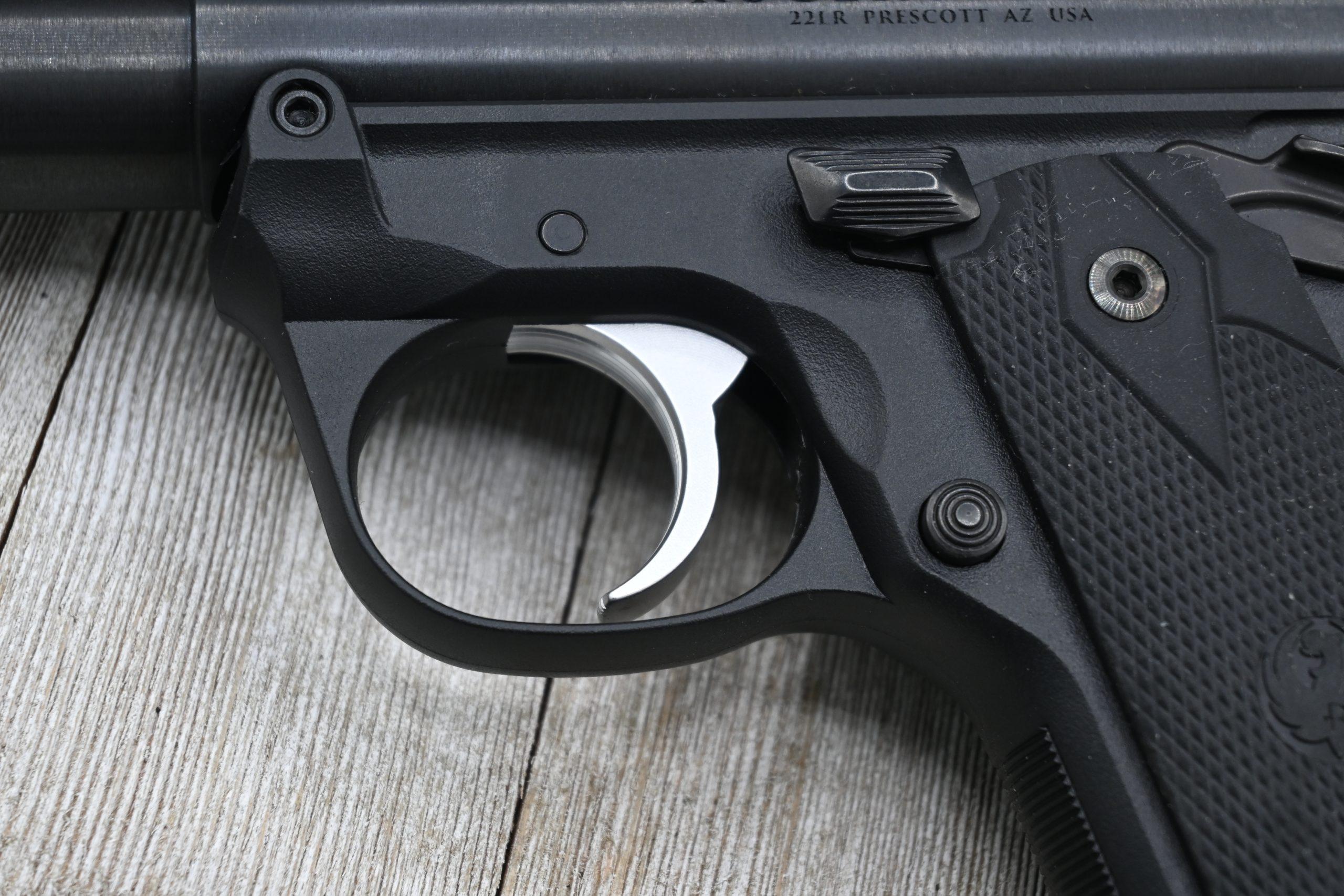
Controls are accessible and positive throughout: the safety lever actuates without requiring a grip shift, the mag release breaks cleanly without excessive thumb pressure, and the trigger guard provides adequate clearance for gloved shooting.
The bolt ears sit high enough on the tubular receiver to give a reliable purchase for racking. Shooters with limited grip strength may find the standard charging handles a bit narrow for positive manipulation, particularly with a suppressor attached.
Aftermarket oversized charging handles from TandemKross and Volquartsen are a quick fix and among the first upgrades most owners make.
I’ve always felt the 22/45’s grip angle was its most underrated feature. It’s not marketing — the muscle memory transfer from a 1911 to the 22/45 is genuine, and anyone training on a budget will notice it after a range session or two.
We rate the Mark IV at 4 out of 5 for ergonomics overall. The grip angle, accessible controls, and slim profile all earn high marks. The trigger guard runs a touch wide for some hands, and the factory grip panels lack the texture needed for a positive hold under sustained fire. Both are fixable with aftermarket parts, which is part of the platform’s appeal.
Outfitting and Optics — Red Dot and Rails
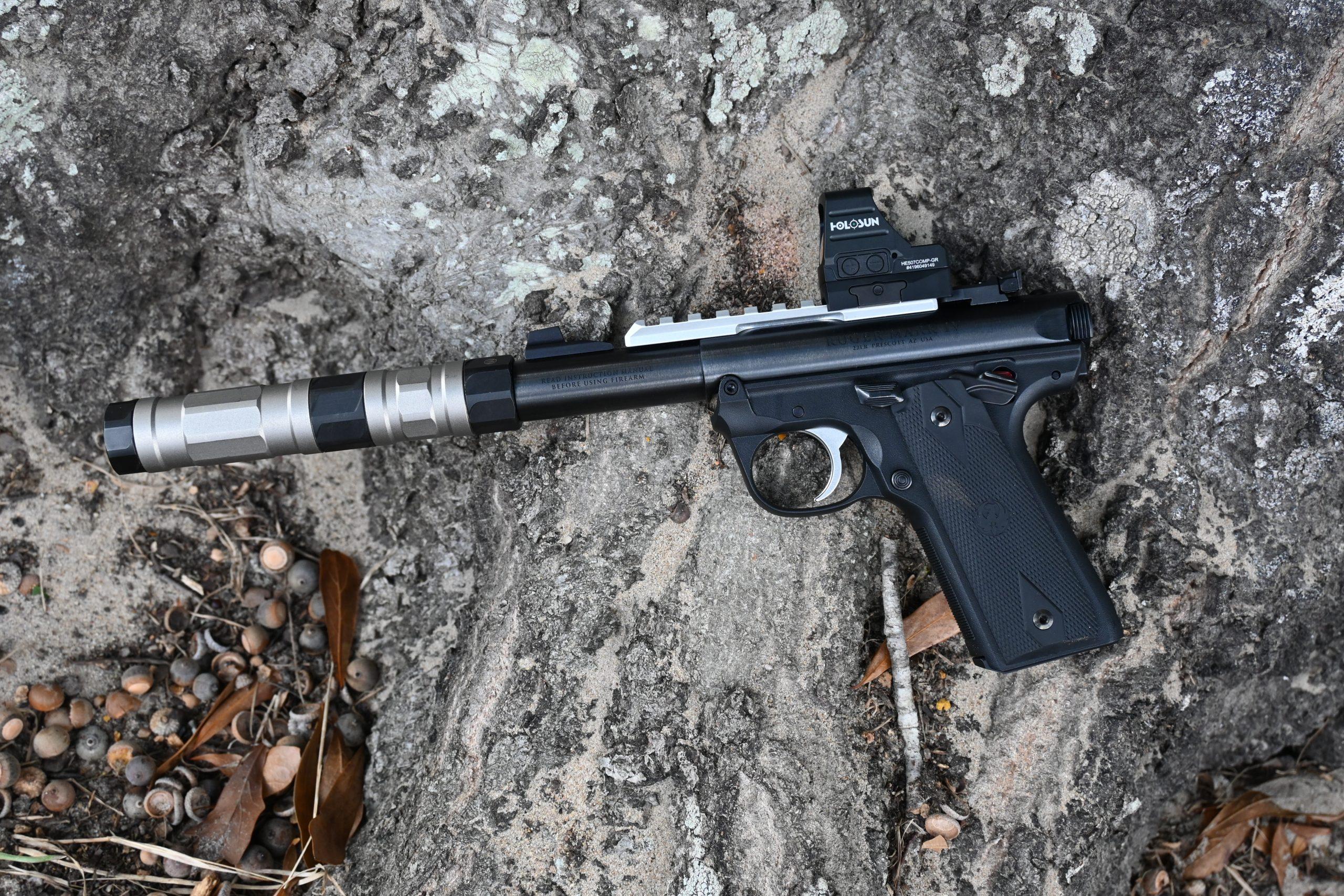
The Tactical and SSH include a Picatinny rail as standard equipment, making red dot sight mounting straightforward with any mil-spec direct-mount plate or riser. The Target model is drilled and tapped for Weaver- or Picatinny-style bases; a dedicated rail base from Ruger or the aftermarket is required before a red dot can go on.
For micro red dots, the Holosun 507K, SIG Romeo Zero Elite, and Trijicon RMR Type 2 all mount cleanly on Tactical-spec rails. Full-size red dots — Trijicon MRO, Aimpoint Micro T-2 — work but shift the balance point noticeably on the shorter 22/45 frame. For Steel Challenge competition, a micro dot is the practical choice: minimal sight radius on a .22 pistol does not benefit from a large housing, and the weight savings matter across extended strings of fire.
The SSH has no iron sights and no pretense otherwise. Ruger’s intent is that this pistol runs an optic, full stop. A dead battery means a sightless pistol for the SSH owner — worth knowing before purchase.
For shooters who prefer iron sights, the Target’s adjustable rear sight and fixed front sight are fully serviceable out of the box. A fiber optic front sight upgrade — available from Ruger and TandemKross in the $20–$30 range — meaningfully improves sight acquisition speed and is the first upgrade I’d recommend to any Mark IV owner who hasn’t gone optic yet. It makes a genuine difference in getting a fast, clean sight picture under range lighting.
For a deeper look at red dot options across calibers and platforms, see our best pistol red dot sights guide.
Suppressors and Short Barrel Options
The Mark IV’s standard thread pitch on threaded barrel models is 1/2×28 — the same pattern found on most 9mm suppressors. If you already own a 9mm can, there is a reasonable chance it will thread directly onto a Mark IV Tactical or Target barrel. Confirm compatibility before mounting it, though: not all 9mm suppressors are rated for .22 LR rimfire, which burns substantially dirtier and will compromise baffles in a can that cannot be disassembled for cleaning.
The Mark IV also uses a fixed barrel design, which means suppressors must attach via direct thread without a booster or Nielsen Device. Do your homework before heading to the range.
The Silencer Shop SSH addresses the most common Mark IV suppressor-host complaint: overall length once a can is threaded on. By trimming the barrel to 3 inches, Ruger and Silencer Shop reduce the suppressed OAL to something genuinely manageable — particularly when paired with short-stack rimfire cans like the Bowers Bitty, SilencerCo Switchback in micro configuration, Rugged Oculus, or FOR Pluto Micro. The SSH is available in blued, FDE, and OD green Cerakote with a Silencer Shop direct price that has been as low as $559.
Aftermarket companies offer replacement uppers for the Mark IV that come threaded for suppressors — Tactical Solutions and Volquartsen being the most recognized. The important caveat: these uppers are serialized parts under ATF regulations. They transfer through a licensed dealer with a background check and FFL transfer fee of $25–$75, same as a complete firearm. Integrally suppressed uppers — TacSol’s PAC-LITE IV TSS, for instance — add full NFA compliance requirements to the equation.
Eight states still ban consumer suppressor sales, and the red tape remains even where the $200 tax stamp has been suspended. Know the rules before you order.
Ammo selection matters significantly for suppressed use. Subsonic loads at 1,050 fps and under are ideal for maximizing the suppressor’s effectiveness, but the reduced energy impulse can produce failures to extract in some Mark IV configurations, particularly with fully-loaded magazines and no can attached. We found CCI Standard Velocity and CCI Subsonic to be reliable in our suppressed evaluation unit. Other loads were more problematic — which the range data section covers in detail.
Range Testing: Accuracy, Trigger, Reliability
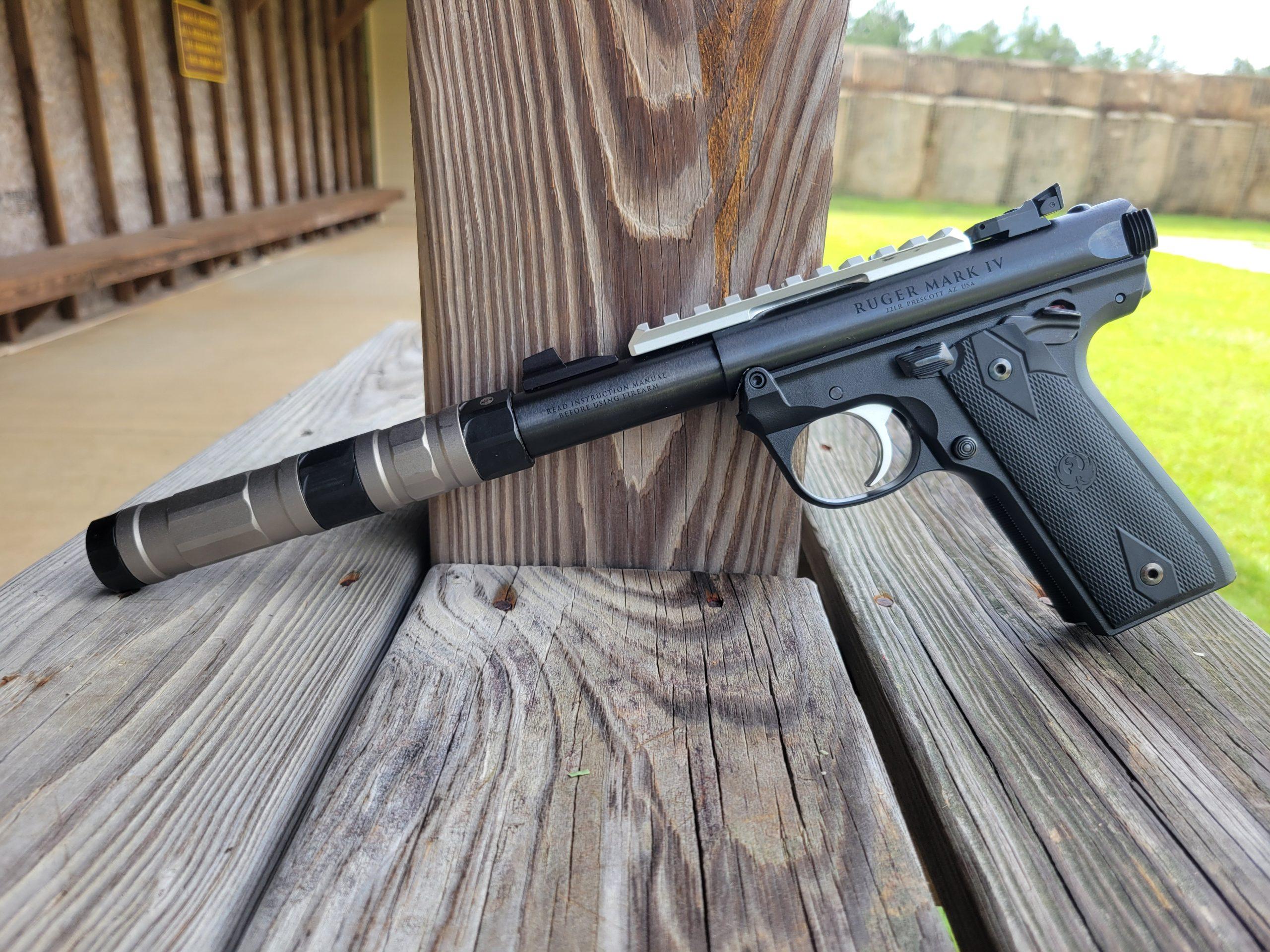
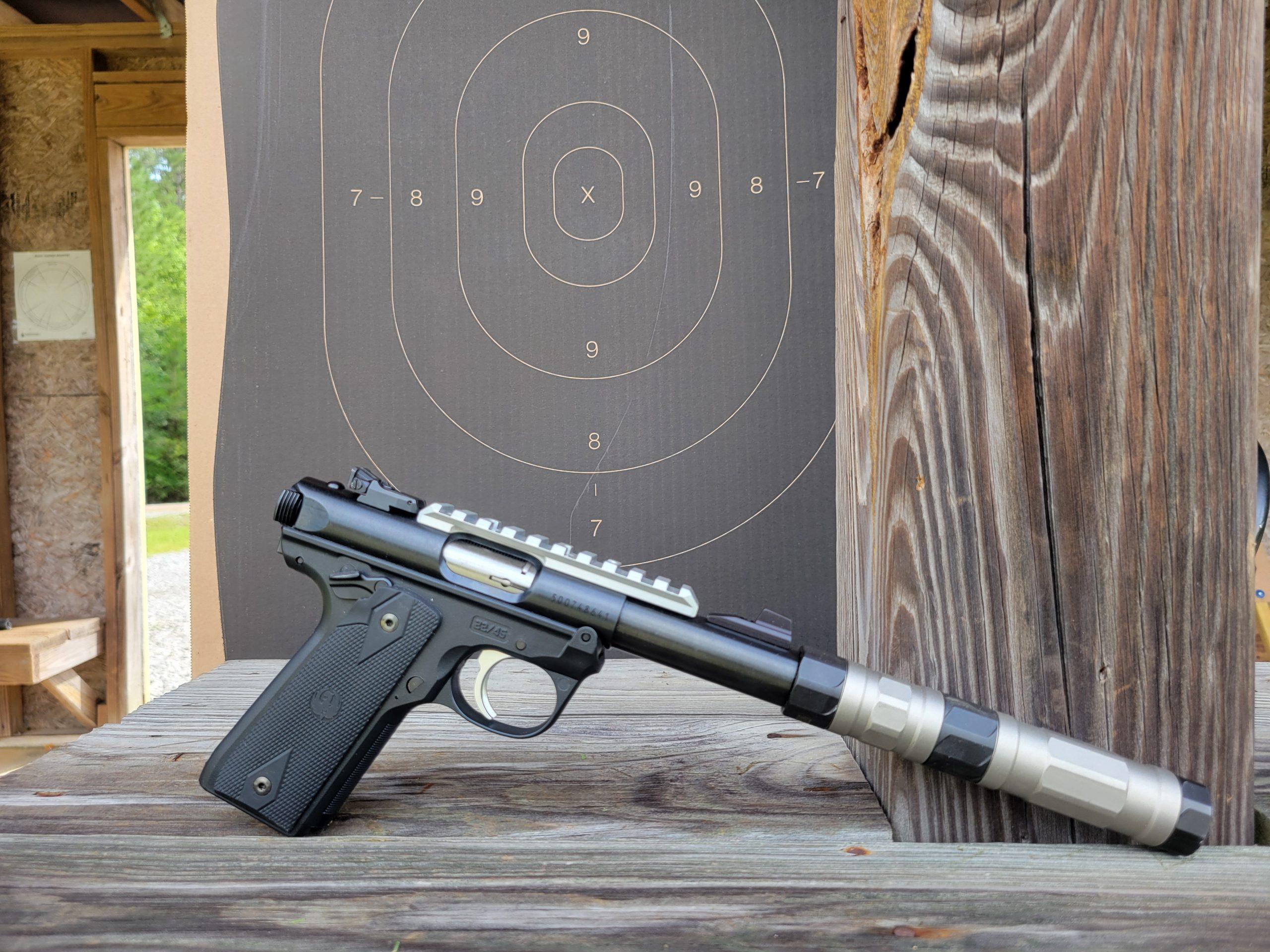
The primary model we evaluated was the Mark IV 22/45 with a 4.4-inch threaded bull barrel. Range sessions were conducted at 25 yards from a bench with a sandbag for support using factory-installed iron sights and the stock trigger and bolt.
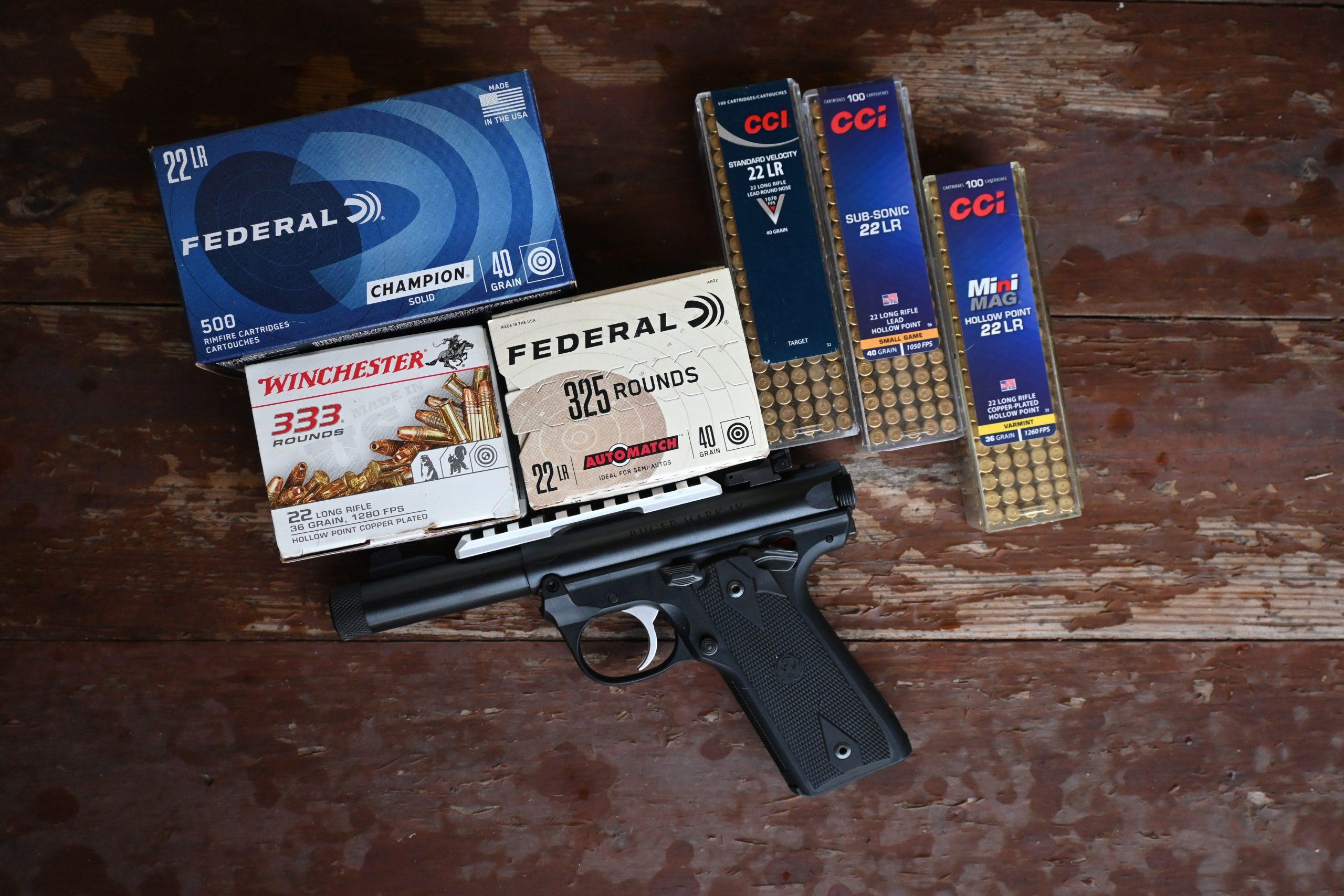
We ran 1,858 rounds drawn from six factory loads: CCI Standard Velocity 40gr lead target (1,070fps), CCI Sub-Sonic 40gr lead HP (1,050fps), CCI Mini-Mag HV 36gr copper-plated HP (1,260fps), Federal Champion target solid HV 40gr (1,240fps), Federal AutoMatch 40gr HV solid (1,200fps), and Winchester HV bulk pack 36gr copper-plated HP (1,280fps). Roughly half of each load was fired with a SilencerCo Switchback suppressor installed in its full-length configuration.
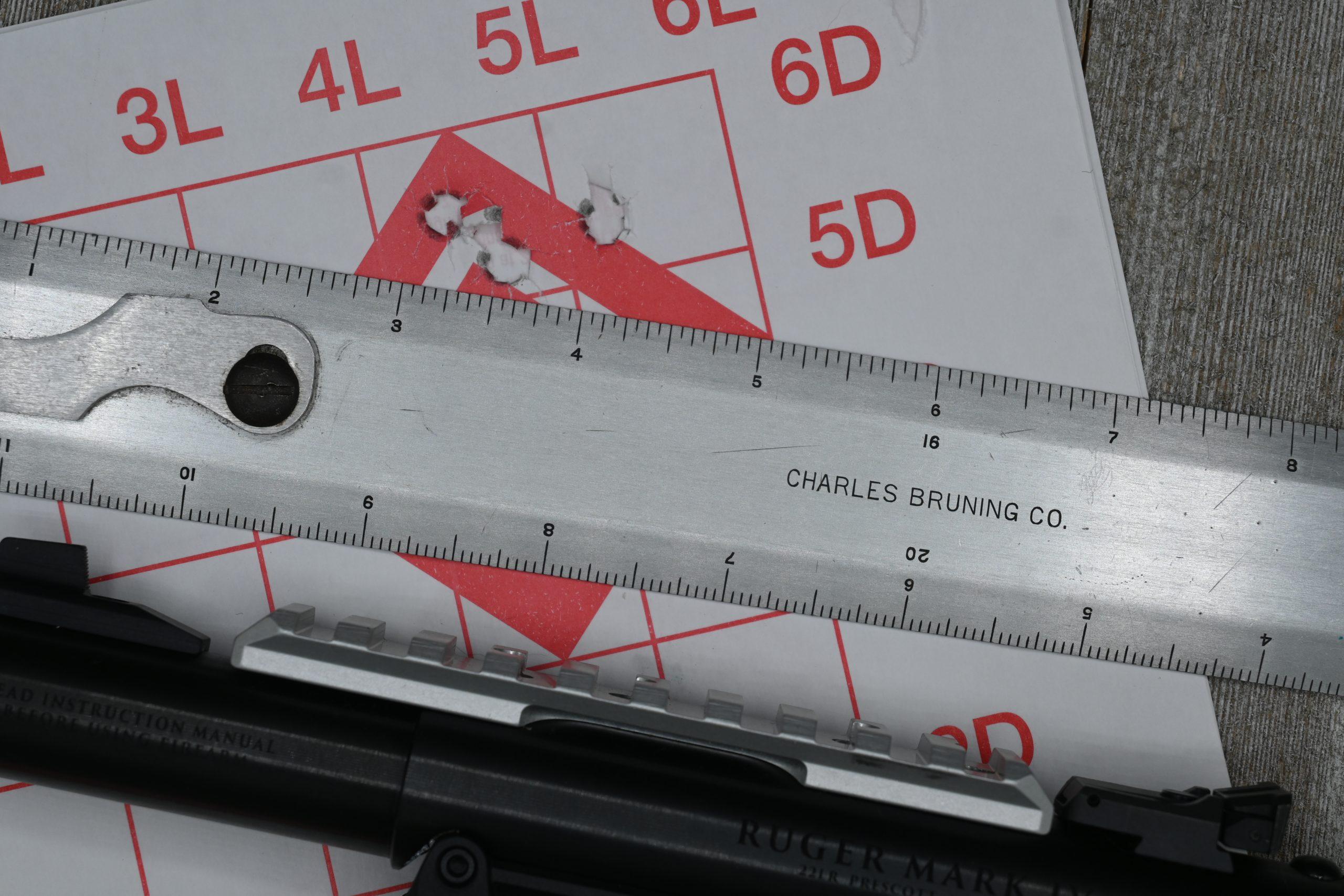
Accuracy: We had no difficulty framing hits on 4-inch target circles at 25 yards with every load tested. Groups tightened slightly with the suppressor mounted. We pushed out to 50 yards and made consistent hits on 10-inch steel without trouble.
The tightest clusters came from CCI Subsonic — several 10-round groups settled into a 1-inch pocket at 25 yards. For additional reference, the 22/45 has been documented producing a 1.34-inch group with high-velocity Aguila ammunition at 12 yards, consistent with the platform’s known capabilities at closer range.
The Mark IV Target, it’s worth noting, has demonstrated 1-inch groups at 25 yards using bulk Federal 36gr plinking ammo from a bench rest — a meaningful benchmark for a rimfire pistol in this price tier.
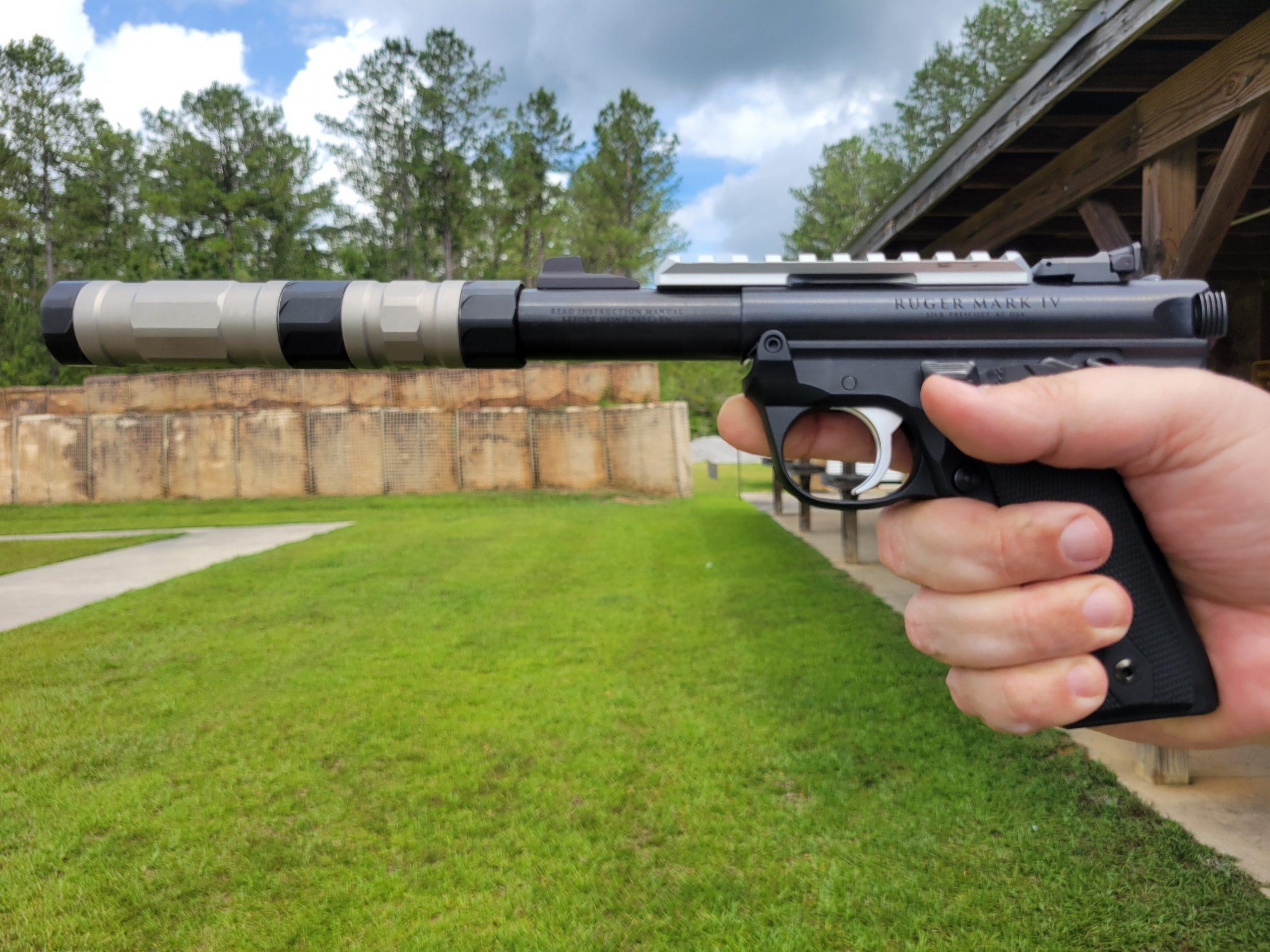
Trigger: We measured trigger pull on our test 22/45 with a Lyman digital gauge. The average across five pulls came to 3.8 pounds, with a low of 3.6 and a high of 4.1. Pre-travel is short to the wall; the break is fairly crisp; reset is long — a design byproduct of the blowback action that will require adjustment from shooters accustomed to the snappy reset of a striker-fired gun or a 1911.
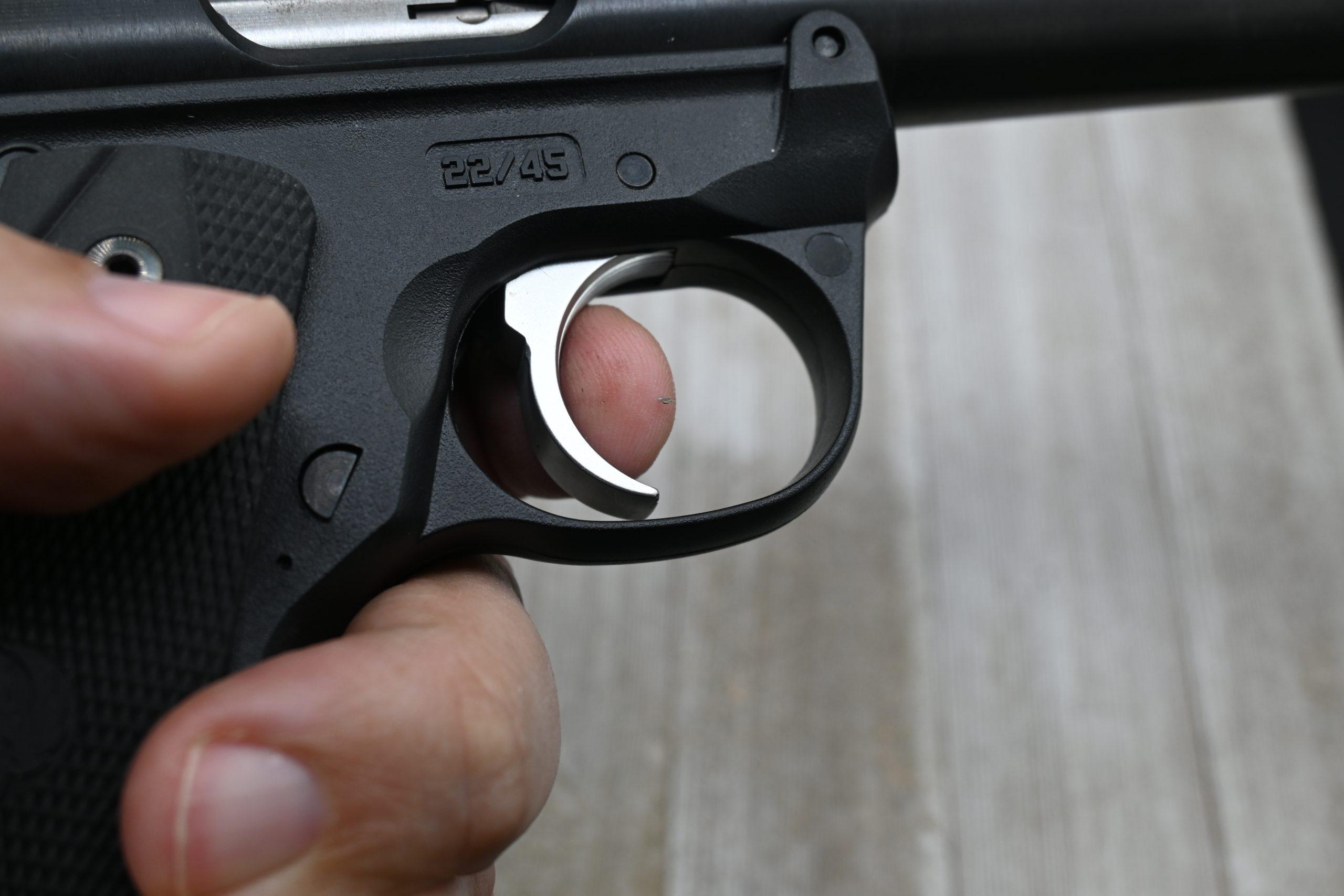
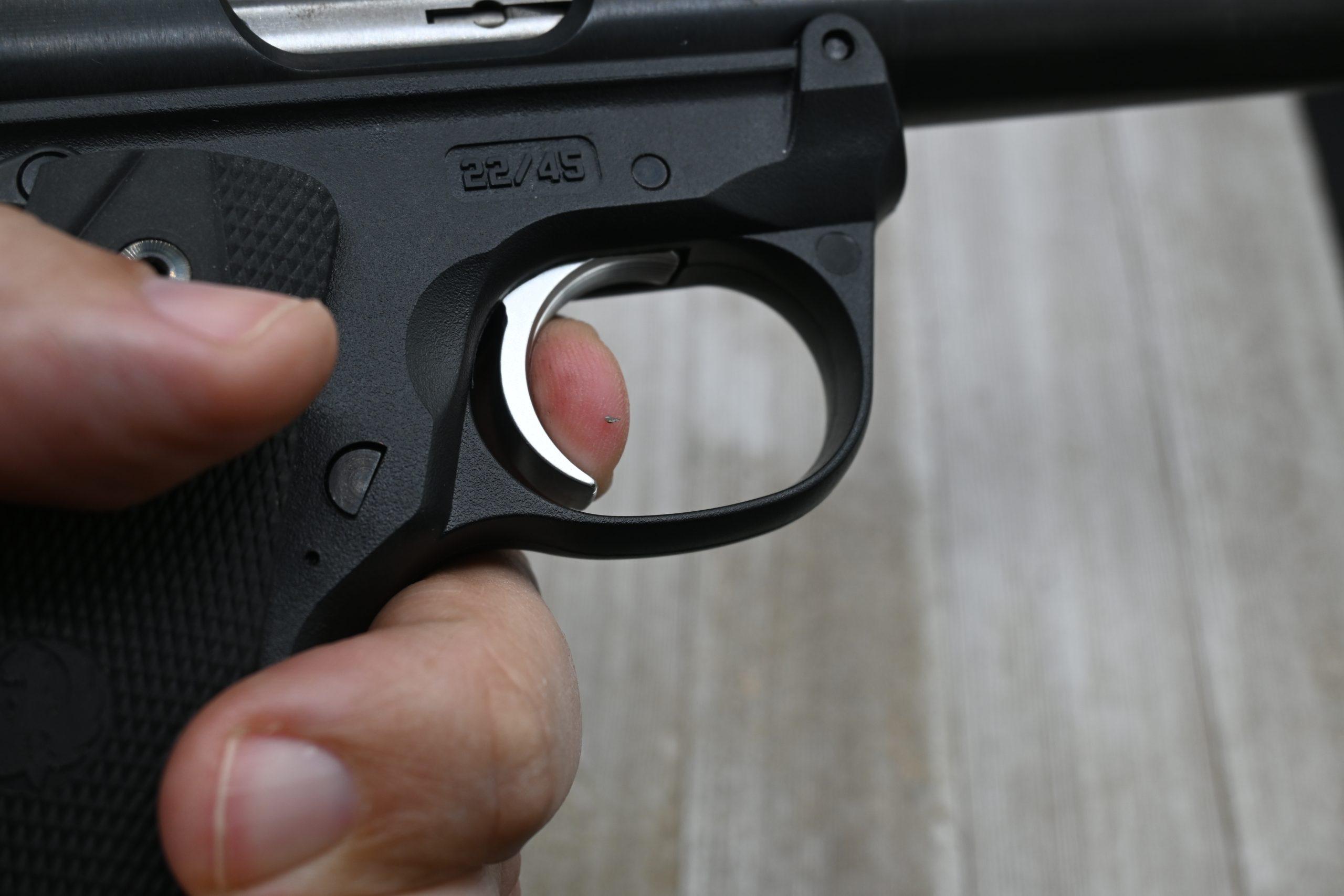
NOTE: A separately cited trigger pull average for the Mark IV family is 3.12 lbs. This likely reflects a different configuration — possibly a Target model with a broken-in or upgraded trigger group rather than our stock 22/45 measured prior to high round counts. Both figures are plausible depending on the specific variant and condition at time of measurement; buyers should treat 3.8 lbs as a conservative expectation for a new stock trigger.
I am no trigger snob, but I found the stock pull predictable and adequate for target shooting and plinking. Competitive shooters coming from the DA/SA world will notice the long take-up and reset immediately. The fix is inexpensive — more on that in the upgrades section.
Reliability: We suffered 52 failures across 1,800+ rounds, with the bulk attributable to one ammo type. Winchester bulk pack was responsible for 28 malfunctions out of 333 rounds — failures to extract, failures to feed, and a handful of duds, often followed by wild flyers when the round did fire.
By contrast, the three CCI loads produced four combined malfunctions across 700 rounds, with three of those occurring on Subsonic fired without a suppressor attached.
| Ammo | Rounds | Malfunctions | Result | Notes |
|---|---|---|---|---|
CCI Standard Velocity 40gr 1070fps | 200 (half suppressed) | 1 FTF (unsuppressed) | Pass | Ran dirty due to un-plated lead; otherwise reliable |
CCI Sub-Sonic 40gr HP 1050fps | 300 (half suppressed) | 3 (2 FTE 1 FTF — all unsuppressed) | Pass | Flawless with can mounted; tightest groups at 25 yards |
CCI Mini-Mag HV 36gr 1260fps | 200 (half suppressed) | Zero | Pass | Fed and ejected perfectly both ways; ran the cleanest |
Federal Champion HV 40gr 1240fps | 500 (half suppressed) | 16 (FTF + duds) | Pass/Marginal | Left the gun very dirty; higher failure rate than most loads |
Federal AutoMatch 40gr 1200fps | 325 (half suppressed) | 4 (FTE + duds) | Pass | Decent bulk-pack performance overall |
Winchester HV Bulk 36gr 1280fps | 333 (100 suppressed) | 28 (FTE/FTF/duds) | Fail | Jams on nearly every magazine; wildly inconsistent on target |
The Mark IV is a semi-auto rimfire pistol, and no semi-auto rimfire comes with a jam-free guarantee. Rimfire ammunition is inherently less consistent than centerfire, and the platform reflects that reality. What the Mark IV delivers is excellent reliability with quality high-velocity loads, plus a field strip process that gets the gun back in action quickly when it eventually gums up past a thousand rounds.
Plus, when it does get dirty, the one-button takedown means you are not cursing at the bench for twenty minutes before you can wipe the bolt face. That combination is worth more than it sounds after a long range day.
Field Strip, Reassembly, and Maintenance
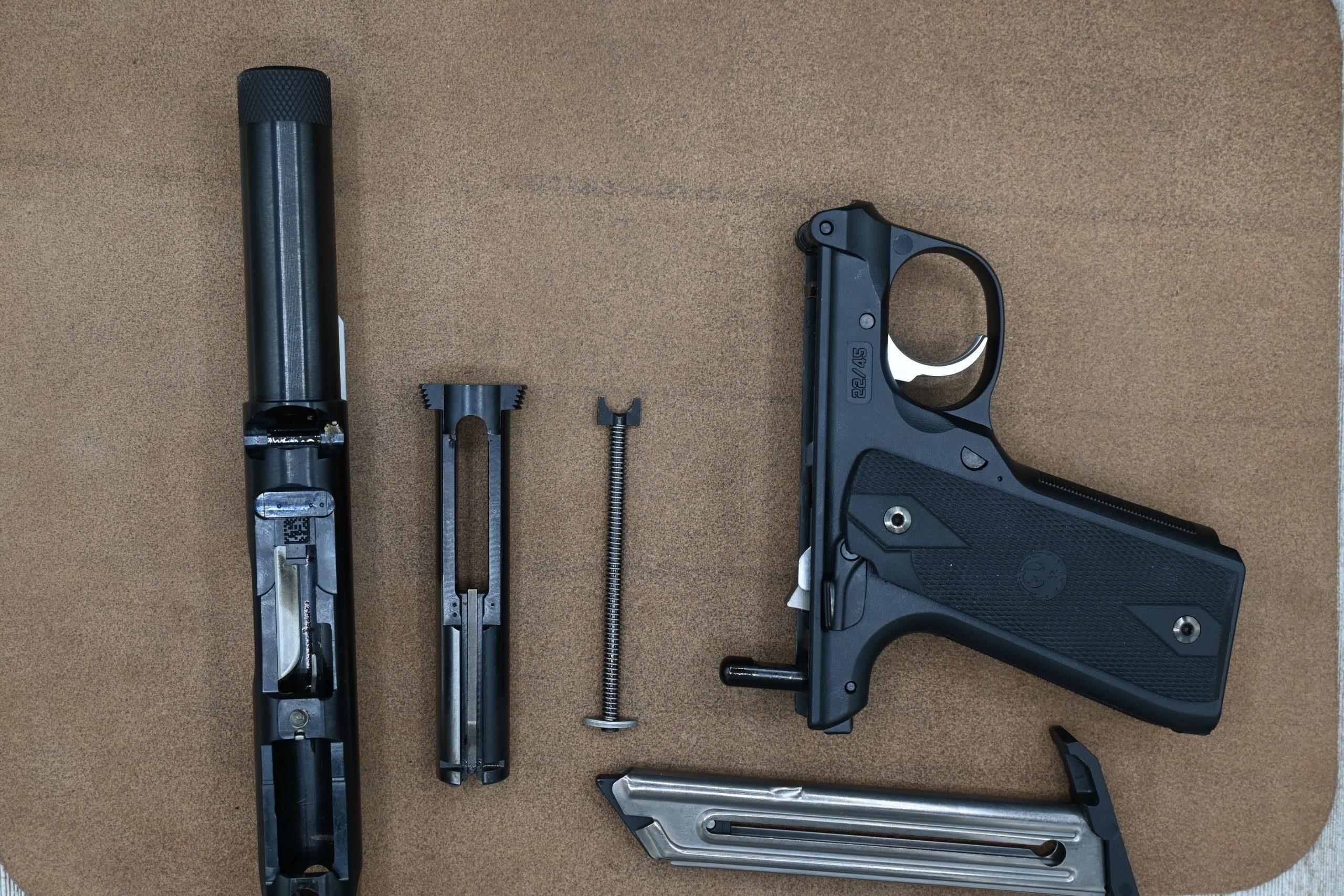
The Mark IV field strip process is the reason Mk III owners upgraded. Here is the full sequence:
- Remove the magazine. Rack the bolt and lock it open. Verify the chamber is clear.
- Engage the manual safety.
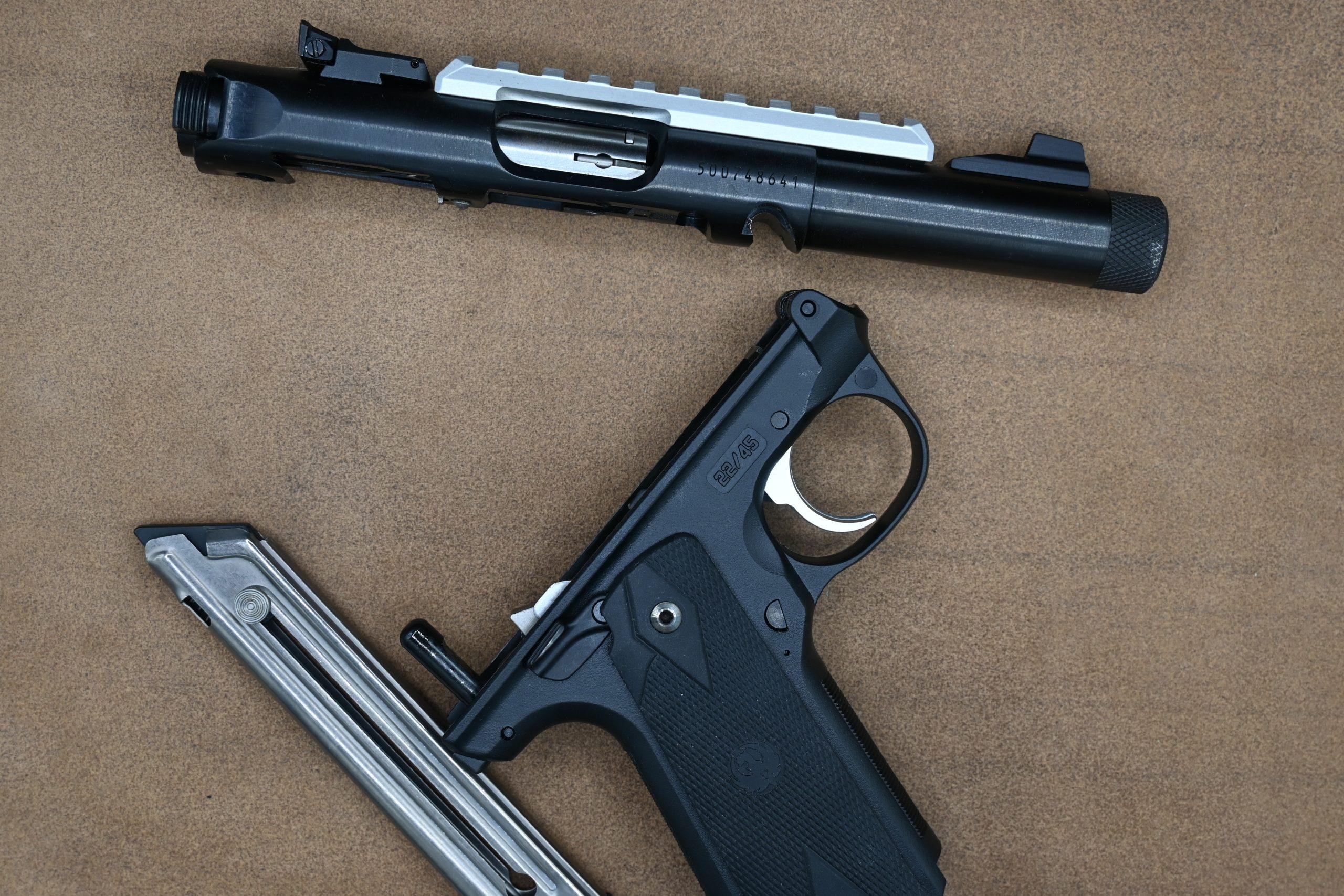
- Press the takedown button at the rear of the frame, below the bolt ears. The barrel assembly tilts upward freely.
- Lift the barrel-receiver assembly free of the grip frame.
- Slide the bolt rearward and out of the barrel assembly.
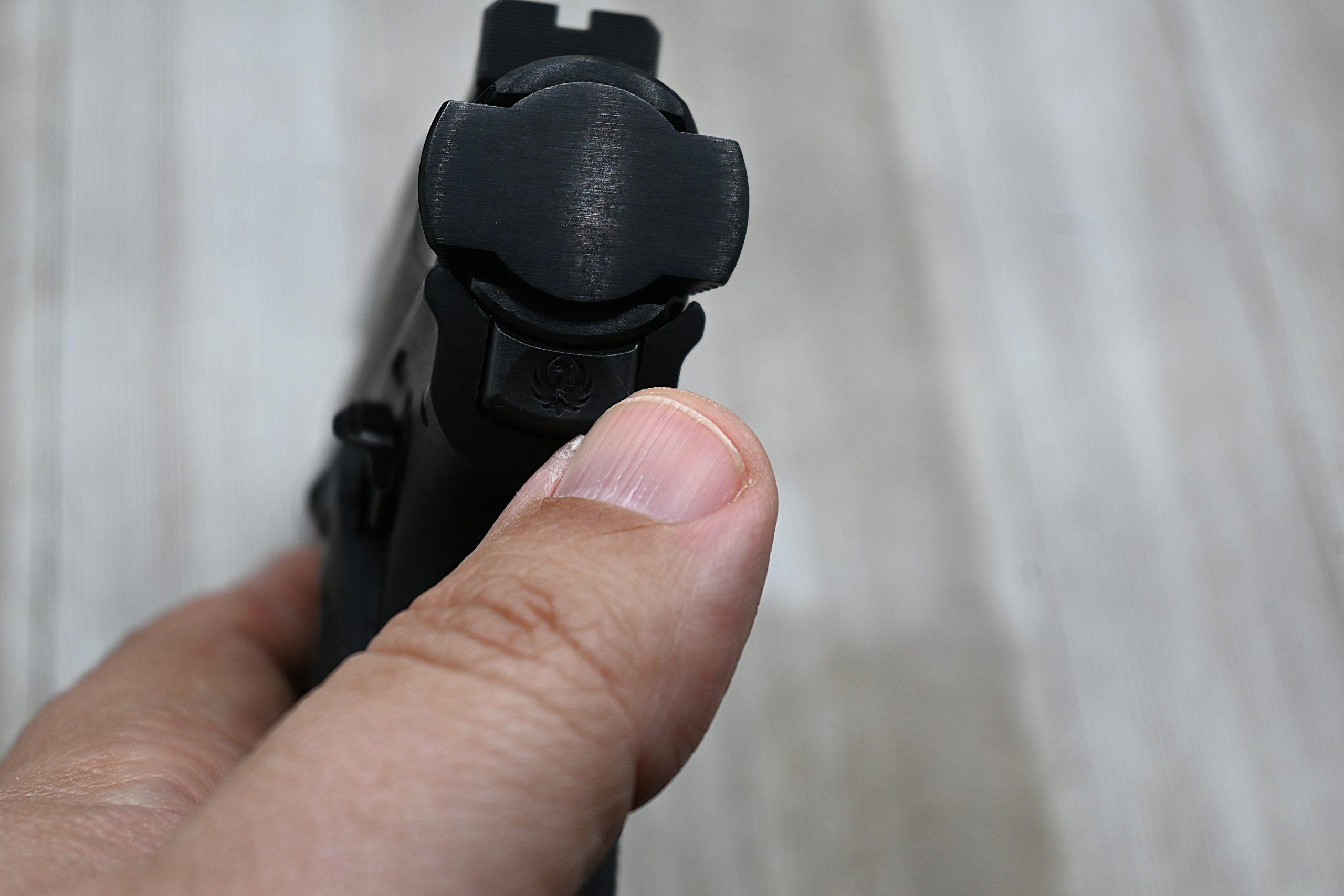
Result: four components — grip frame, barrel assembly, bolt, magazine. Accessing all internal components for a thorough cleaning requires no additional steps and no complicated reassembly procedures. Users regularly report running 1,500 rounds before their first cleaning and returning the pistol to full function without issue. That tracks with our experience on the evaluation unit.
Customization and Upgrades
The Mark IV has a mature aftermarket ecosystem — among the most developed available for any rimfire pistol on the market. TandemKross and Volquartsen are the two primary suppliers; between them, nearly every component can be improved. Owners can change out triggers, barrels, grips, sights, charging handles, and bolt assemblies, allowing for extensive customization at virtually every price point.
Trigger: The TandemKross Timberwolf flat-faced trigger shoe and the Volquartsen trigger group are both proven upgrades. A quality trigger kit drops pull weight from the factory 4–5 lb. range to approximately 2.5–3 lbs. with a cleaner break and shorter reset. This is the most impactful single upgrade for the Mark IV.
Bolt: The Volquartsen Competition Bolt ships with three recoil springs — standard, reduced power, and extra power. The reduced power spring is tuned for suppressed subsonic use; the extra power spring addresses cycling failures with weak ammunition. SSH owners running varied ammo loads should keep all three on hand.
Grips: Hogue Extreme Series G10 panels in the Piranha pattern are a widely recommended replacement for the factory rubber panels, offering significantly more texture in black, olive drab, and grey. The 22/45’s polymer frame cannot be stippled without risk of damage, making aftermarket panels the primary grip customization route.
Sights: The TandemKross fiber optic front sight is a direct replacement for Target and 22/45 models — faster sight acquisition, no gunsmithing required, under $30. It is a genuine improvement in building a fast, clean sight picture, especially in variable range lighting.
Charging handles: Oversized units from TandemKross and Volquartsen improve manipulation for suppressed configurations and for any shooter whose hands find the stock handle too narrow for a reliable rack. Easy upgrade, immediate benefit.
Aftermarket companies also provide replacement uppers with threaded barrels and integrated Picatinny rails, expanding the customization potential of the platform significantly. The FFL transfer implications for serialized uppers apply here, as detailed in the suppressor section above.
How should you use the Mark IV?
The Mark IV covers more practical ground than its price suggests.
Target shooting and competition: The 22/45 Lite is a Steel Challenge staple. Light weight, mild recoil, and reliable rimfire feeding produce competitive split times at a fraction of centerfire operating cost. The full-size 22/45 and Target models appear regularly in bowling pin matches and rimfire precision leagues. With a quality trigger kit and a red dot installed, either can become a genuinely competitive pistol without a significant investment.
Training: The 22/45’s grip angle is the entire argument for budget-conscious training. Shooters who carry a 1911-pattern pistol can reinforce muscle memory at rimfire cost — approximately $0.07 per round versus $0.35 or more for .45 ACP. The mild recoil also makes the Mark IV effective for introducing new shooters to semi-automatic pistols. It doesn’t intimidate. New shooters enjoy shooting it immediately, which matters more than most instructors acknowledge out loud.
Suppressed pest control: The Tactical and SSH models make discreet pest control practical. A suppressed .22 LR is hearing-safe outdoors in most jurisdictions and quiet enough to avoid alarming livestock or neighbors at reasonable distances. Fun to shoot, genuinely useful on a working property. The two are not mutually exclusive.
Holster note: Kydex options for the 22/45 Tactical are available from Comp-Tac, Safariland, and several custom makers. SSH owners running a mounted suppressor will need a custom or modular solution — no factory holster accommodates that configuration.
Final Ratings
| Category | Rating | Notes |
|---|---|---|
Reliability | 4.5 / 5 | Excellent with HV ammo; occasional FTE with low-powered or bulk loads |
Ergonomics | 4 / 5 | Slim grip suits smaller hands; 22/45 grip angle is a genuine 1911 analog; positive controls |
Accuracy | 4.5 / 5 | Cold hammer-forged barrel; 1" groups at 25 yards achievable with quality ammo |
Value | 5 / 5 | $325 street for 22/45; deep aftermarket ecosystem compounds the investment over time |
Ease of Maintenance | 5 / 5 | One-button takedown is transformative versus Mk I through III |
FAQs
Are Ruger Mark IV pistols reliable?
Is the Ruger Mark IV better than the Glock 44?
What is a Ruger Mark IV good for?
Can I mount a red dot on the Mark IV?
What thread pitch does the Mark IV use?
How long can I go between cleanings?
Sign up for our newsletter
Get discounts from top brands and our latest reviews!
View by Category

In-Hand Reviews

Firearm News

Featured Comparisons

Firearm & Ammo Reviews

Popular Guides & Stats

Range Gear & Accessories

Gun & Ammo Safes