Diamondback Firearms Review [2026]: Complete Guide to All Models
Complete Diamondback firearms guide: DB15 AR-15, DB9 pistol, DB10 .308 reviews. Real-world testing, vs. PSA/Ruger comparisons. Expert buying advice.

Written By
Michael Crites
Licensed Concealed Carry Holder
Reviewed by
Editorial Team
Learn About The Editorial Team
Share:
Products are selected by our editors. We may earn a commission on purchases from a link. How we select gear.
Updated
Dec 2025
Diamondback Firearms is one of those companies that many have only “heard” about but haven’t had a chance to deal with as, when compared to gun makers like S&W or Ruger, they are seen as newcomers.
However, don’t be confused, this Florida-based company is a juggernaut building up steam when it comes to production, while their quality and selection check a lot of boxes.
In This Article
How We Tested
Accuracy & Performance
We fire a minimum of four 5-shot groups from a supported bench rest to evaluate accuracy—at 15 yards for micro-compacts, 25 yards for full-size handguns, and 100 yards for rifles.
Reliability
We fire a minimum of 500 rounds for handguns and 1,000 rounds for rifles across multiple range sessions spanning several months.
Durability & Construction
After our initial 500-1,000+ round test protocol, we evaluate wear and tear including any signs of finish degradation, frame or receiver stress points, or accelerated component wear.
Ergonomics & Features
We assess grip comfort, control placement, and overall handling characteristics across different hand sizes and shooting styles.
More on Our Testing Process
Diamondback Firearm Comparison
Below is my list of the best Diamondback firearms. I list the best choices in terms of value, performance, design, and cost.
Click on the name to head to the product page, read reviews and check prices or skip ahead to the list of firearms.
Diamondback Firearm Reviews
1. Diamondback DB380
$229.99

29
AVERAGE
2026 Awards & Rankings
Performance Scores
Other Sellers:



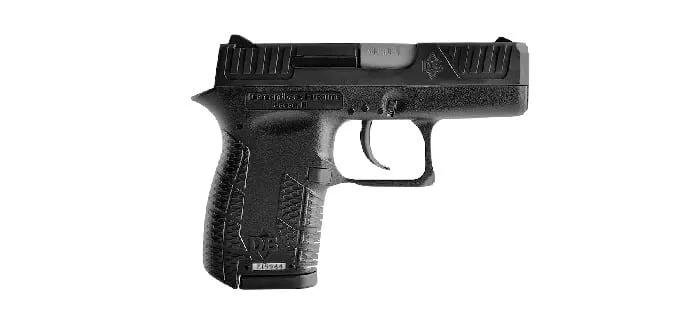
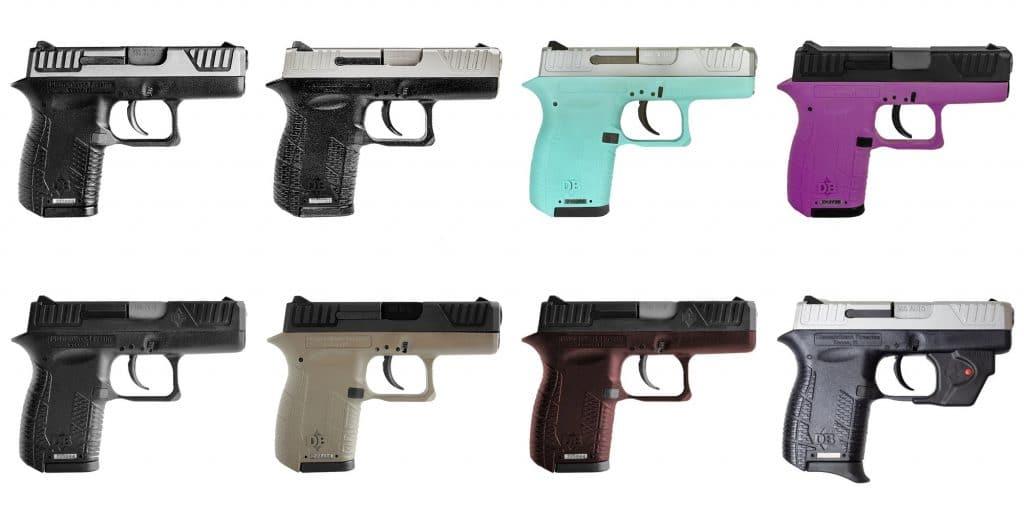
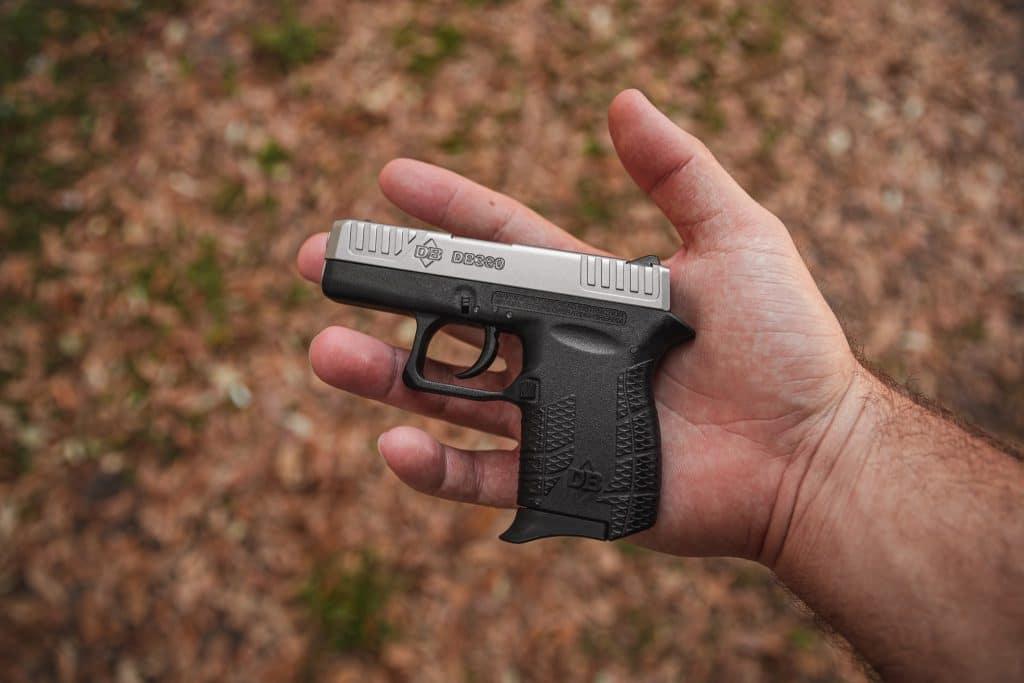
Diamondback’s first handgun– and first firearm for that matter– the .380 ACP caliber DB380, was introduced in late 2009.
A direct (and more affordable) competitor to the Ruger LCP, which had been introduced the year before, the DB380 is an almost exact match in size, using a 2.8-inch barrel, giving it an overall length of just over 5-inches.
Height, a key factor for deep carry or pocket carry, was under 4-inches. The simple DAO blowback design uses a single-stack, 6-shot magazine and weighs just 8.8-ounces. Over the past decade, Diamondback has made continual updates to the DB380, and today’s guns have both a different external appearance as well as better ergonomics and reliability.
With that in mind, it is always a better idea to buy a new DB380 rather than a used one.
Key Features
- Ultra-compact dimensions: At just 5.1 inches long and 3.9 inches tall, the DB380 fits comfortably in most pockets
- Lightweight carry: 8.8 ounces unloaded makes it one of the lightest .380 pocket pistols available
- DAO trigger with integrated safety: Simple manual of arms with consistent trigger pull
- Improved generation updates: Current models feature better grip texture, improved feeding geometry, and more reliable extractors than early production
- Affordable entry point: Typically $100-$150 less expensive than comparable Ruger or S&W options
Best For
The DB380 excels as a deep concealment backup gun, pocket carry option for situations where larger pistols won’t work, or as an affordable first defensive handgun for budget-conscious buyers. It’s ideal for users who prioritize ultimate concealability and light weight over capacity and shootability.
Pros
- Price: At $230-$280 street price, it’s one of the most affordable defensive .380s on the market
- Size and weight: Genuinely disappears in a pocket in ways heavier micro-compacts don’t
- Simplicity: DAO trigger means no manual safety to forget under stress
- Continuous improvement: Later generation models address early reliability concerns
Cons
- Limited capacity: 6+1 capacity is roughly half what modern competitors offer (LCP Max: 10+1, Bodyguard 2.0: 10+1)
- Generation confusion: Used market can include early-generation guns with known reliability issues—always buy new or verify generation
- Difficult ergonomics: Small size means recoil is snappy and the grip accommodates only two fingers for most shooters
- Sight acquisition: Small fixed sights are adequate but not ideal for precision
Who Should Buy This
The DB380 makes sense for experienced shooters who need an ultra-lightweight backup gun for deep concealment situations—ankle carry, pocket carry in lightweight clothing, or off-body carry in small purses. It’s also viable as a first gun for buyers on an extremely tight budget who understand the capacity limitations. If you’re specifically seeking the lightest possible .380 and don’t need high capacity, the DB380 delivers.
Alternative Considerations
- Ruger LCP Max ($350-$400): Nearly double the capacity (10+1 or 12+1) in a package only 1.8 ounces heavier—worth the extra $120 for most users
- Smith & Wesson Bodyguard 2.0 ($380-$430): Modern optics-ready platform with 10+1 capacity and better ergonomics
- Ruger LCP II ($280-$330): Improved sights and trigger over original LCP, similar size to DB380
Current Availability
Status: In Production – The DB380 remains in Diamondback’s active catalog with at least eight different finish options including black, FDE, pink, purple, and various frame/slide color combinations. Extended 7-round magazines are available as aftermarket upgrades.
My Take: With an always-buy-new recommendation due to generational improvements, the DB380 serves a specific niche. For $50-$80 more, I’d recommend the Ruger LCP Max’s doubled capacity.
But if you’re operating on an absolute shoestring budget or specifically need the lightest possible pocket gun, the current-generation DB380 is a functional option that won’t break the bank.
2. Dimaondback DB9 Pistol

$240.99
31
AVERAGE
2026 Awards & Rankings
Performance Scores
Other Sellers:
Taking their svelte little .380 striker-fired polymer-framed pocket pistol, the DB380, as a starting point, in 2011 Diamondback introduced the 9mm DB9. Still, with a 3.1-inch barrel and a slim, single-stack 6+1 shot magazine capacity, Diamondback describes their gun as the “smallest and lightest” 9mm on the market.
At 4-inches high, it is still pocketable.
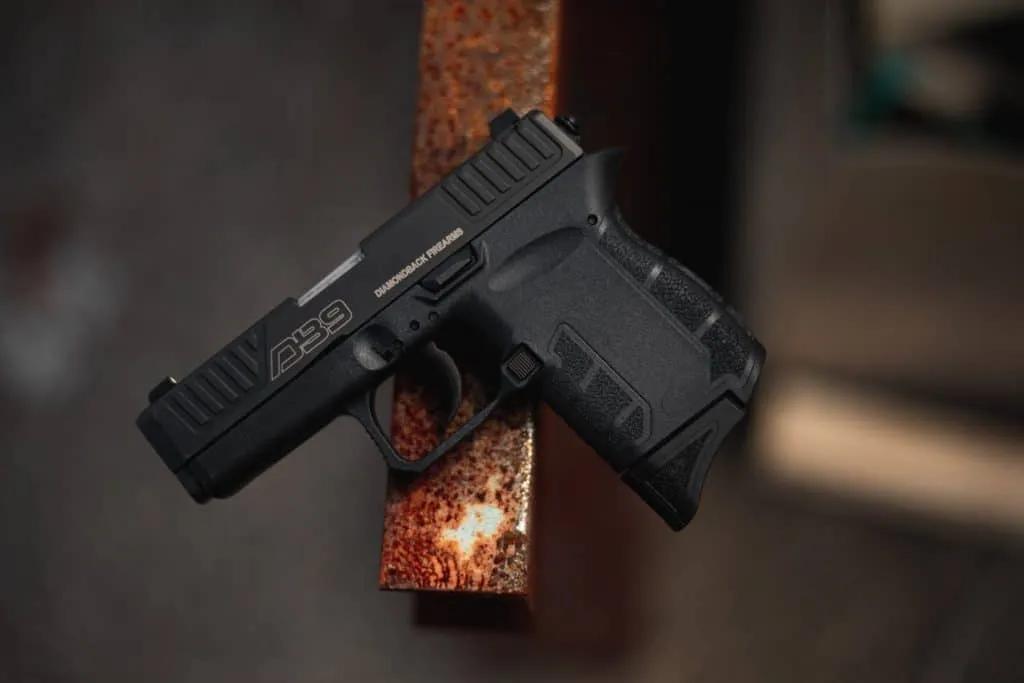
The maximum width is 0.89-inches, and the maximum length is 5.7-inches. Weight, with a loaded mag and one in the pipe, is in the 17-ounce range.
As with the DB380’s evolution, Diamondback has made continual quiet updates on the DB9 series based on user feedback and warranty claims to make the guns better and the current model is the DB9 Gen 4, which includes front and rear slide serrations. Smaller than the comparable Kahr CM9, Ruger EC9S, and SCCY CPX-2, the DB9 is tough to beat in its category, especially considering the price.
Key Features
- Lightest 9mm in class: At just 13.5 ounces loaded, it’s significantly lighter than comparable EC9s (17.2 oz), Shield (20.2 oz), or GX4 (18.7 oz)
- Gen 4 improvements: Front and rear slide serrations, improved extractor geometry, better feeding ramp angles
- Glock-pattern sights: Easy aftermarket upgrades to Tritium or fiber optic options without custom machining
- Slimmest 9mm profile: 0.89-inch width makes it genuinely pocketable
- ZERO Energy striker system: Diamondback’s proprietary firing system designed to prevent accidental discharge
Best For
The DB9 Gen 4 is purpose-built for deep concealment carry where weight is the primary concern—pocket carry in dress pants or suits, ankle holster carry for law enforcement backup, or IWB carry for users who find heavier guns uncomfortable for all-day wear. It’s for experienced shooters who can manage a lightweight 9mm and accept reduced capacity for ultimate concealability.
Pros
- Unmatched light weight: Genuinely the lightest 9mm carry option available—you’ll forget it’s there
- True pocket gun dimensions: Can actually fit in men’s dress pants pockets, unlike most “compact” 9mms
- Price: At $240-$290, it’s one of the cheapest 9mm carry guns from a U.S. manufacturer
- Aftermarket sight compatibility: Glock-pattern dovetails mean dozens of sight upgrade options
Cons
- Limited capacity: 6+1 is roughly half the capacity of modern competitors (EC9s: 7+1, Shield Plus: 10+1, GX4: 11+1)
- Ammunition sensitivity: My testing revealed pickiness with cheap bulk ammunition—stick to quality brass-cased loads
- Snappy recoil: Light weight means sharp felt recoil with +P loads—this isn’t a gun for extended range sessions
- Avoid used Gen 1-3 models: Early generations had reliability issues; always verify you’re getting Gen 4
Who Should Buy This
Buy the DB9 Gen 4 if you’re an experienced pistol shooter who needs the absolute lightest possible 9mm for deep concealment and are willing to sacrifice capacity for weight savings.
It’s ideal for users who already own a higher-capacity primary carry gun and need a backup/deep concealment option for situations where larger guns won’t work. This isn’t a first gun—it’s a specialized tool for a specific job.
Alternative Considerations
- Ruger EC9s ($280-$330): One more round (7+1), proven reliability, only 3.7 ounces heavier—better first-gun choice
- Taurus GX4 ($320-$370): 11+1 capacity in a package only 5 ounces heavier—dramatically better capacity-to-weight ratio
- Smith & Wesson Shield Plus ($450-$500): 10+1 or 13+1 capacity, better ergonomics, costs $200 more but may be worth it
Current Availability
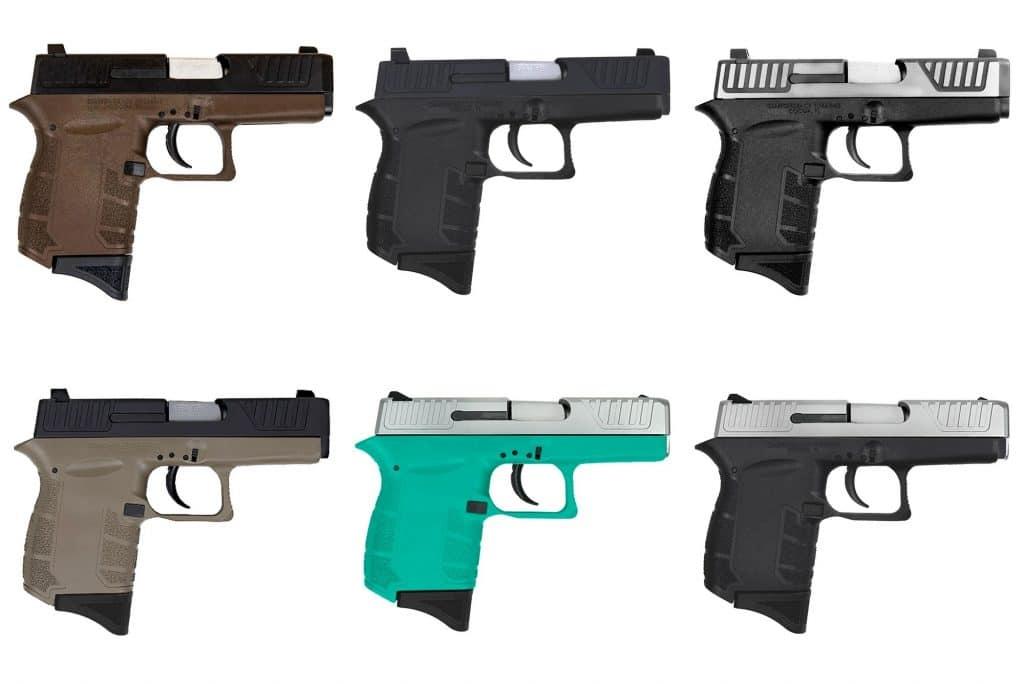
Status: In Production – The DB9 Gen 4 remains Diamondback’s best-selling handgun with current availability in at least six different finishes including black, FDE, stainless slide options, and various frame colors. Extended 7-round magazines are available. Widely stocked at major retailers. Verify “Gen 4” designation when purchasing—earlier generations should be avoided.
My Take: After 800+ rounds through my Gen 4 test gun with only 3-4 malfunctions (all with bargain ammunition), I can confirm this isn’t the problematic DB9 of the early 2010s. That said, for $80 more, the Taurus GX4 gives you 11+1 capacity in a package that’s barely heavier.
The DB9 fills a legitimate niche for ultimate lightweight carry, but most users would be better served by spending slightly more for dramatically increased capacity. If weight is your absolute top priority and you’re committed to quality ammunition, the Gen 4 delivers.
3. Diamondback DB9FS
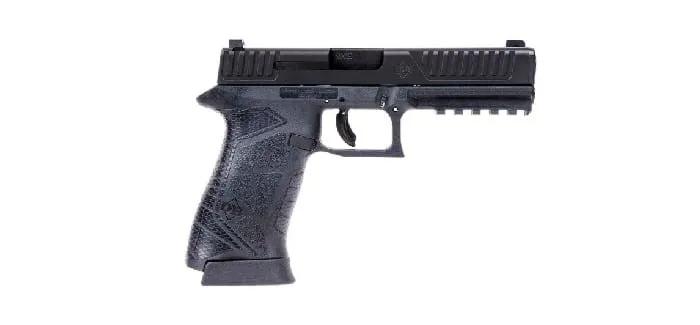
In 2014, Diamondback took a rare swing and a miss, introducing a double-stack full-sized pistol, the logically named DB9FS.
The striker-fired design was available in a 15+1 9mm Para. or .40 S&W with a polymer frame. It had a flared magwell, giving it a sort of race gun look, as well as a decent-sized 1913 Picatinny rail on the dustcover.
The company dropped the .40 S&W variant almost immediately and halted production on the handgun altogether in 2018, pivoting to the more logical AM2. While there are certainly some of these still floating around on the secondary market, support for them may be hard to find.
4. Diamondback AM2
$299.99
31
AVERAGE
2026 Awards & Rankings
Performance Scores
Other Sellers:
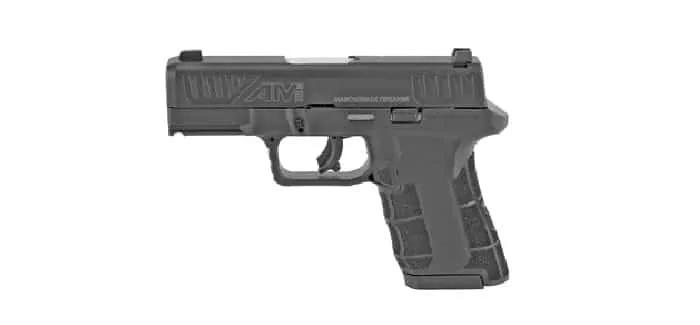
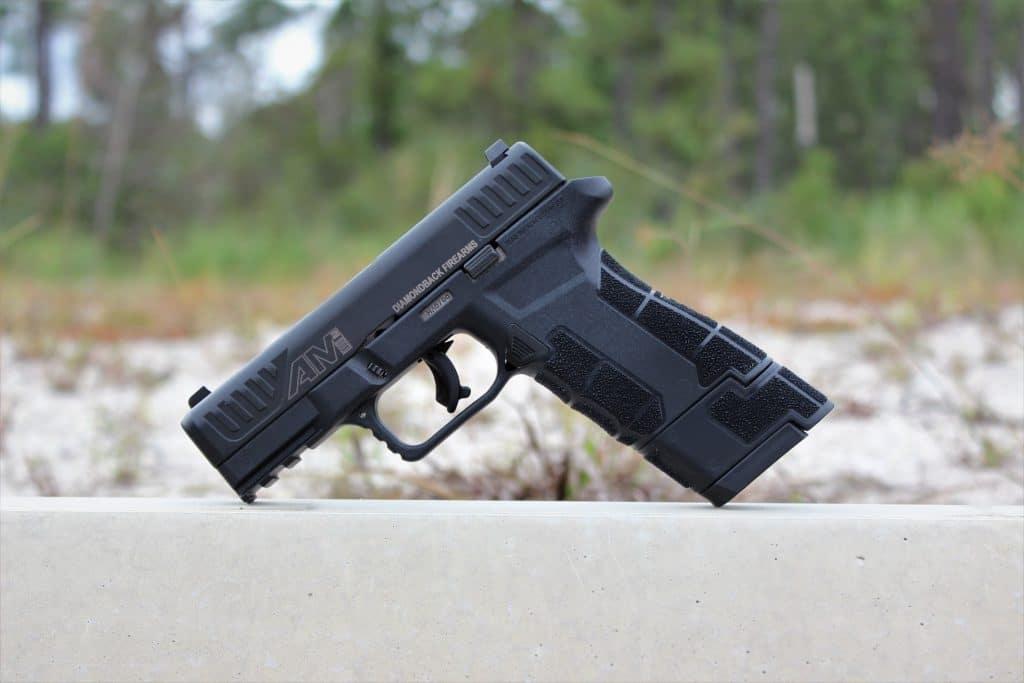
Introduced in 2018 after the company discontinued the problematic DB9FS full-size pistol, the AM2 is a more compact-sized 9mm striker-fired polymer-framed pistol that represents Diamondback’s most competitive handgun offering.
With a barrel just a half-inch longer than the DB9, it’s roughly the same size as the Glock 43X and comes with a flush-fit 12+1 shot magazine while an extended 17+1 shot magazine with grip sleeve is available.
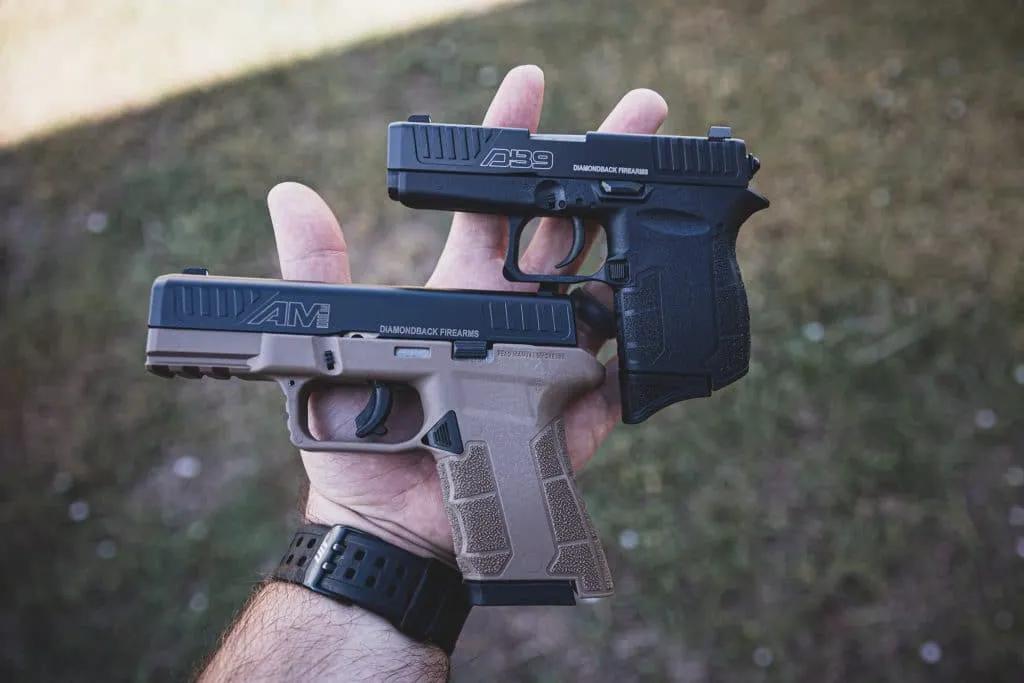
Complete with a Nitrided stainless steel barrel, an integrated trigger safety, 3-dot Glock-pattern sights, as well as front and rear slide serrations, these are an interesting alternative for those looking for an American-made carry gun with a decent magazine capacity.
The AM2 is where Diamondback got the formula right—it’s priced aggressively, uses Glock-pattern sights for easy upgrades, and in my testing has proven as reliable as pistols costing twice as much.
Key Features
- Double-stack capacity: 12+1 flush-fit is competitive with Glock 43X; 17+1 extended transforms it into a home defense option
- Glock-comparable reliability: 1,200+ rounds through my test gun with zero malfunctions
- Nitrided stainless barrel: More corrosion-resistant than standard carbon steel, better longevity
- Integrated trigger safety: Simple manual of arms without external safeties
- Glock sight compatibility: Drop-in sight upgrades available from dozens of manufacturers
- Front and rear slide serrations: Standard features that aid manipulation
Best For
The AM2 is an excellent first carry gun for budget-conscious buyers, a reliable backup gun for experienced carriers, or a capable home defense pistol when loaded with 17-round extended magazines. It’s sized perfectly for IWB carry while offering enough capacity and shootability for serious defensive use.
Pros
- Exceptional value: At $299-$350, it delivers Glock 43X-comparable performance at half the price
- Genuine reliability: My 1,200+ round test with zero malfunctions matches the reliability of pistols costing $200-$300 more
- Capacity options: 12+1 for carry, 17+1 for home defense gives versatility
- Aftermarket sight compatibility: Glock-pattern dovetails mean dozens of upgrade options without custom machining
- Better grip texture than DB9: More aggressive texturing provides better purchase
Cons
- Trigger is serviceable, not great: Comparable to factory Glock triggers—adequate but not crisp, though easily upgraded with aftermarket options
- Limited holster selection: Not as many dedicated holster options as Glock or S&W; some Glock 43X holsters work, but verify fit
- Plastic sights: Factory sights are basic; budget $60-$100 for Tritium upgrades
- No optics-ready option: Unlike newer competitors (Shield Plus OR, GX4 XL), no factory RDS mounting
Who Should Buy This
The AM2 is my top recommendation for first-time pistol buyers on a budget who need a reliable defensive handgun without spending $500+. It’s also excellent for experienced shooters who want a backup gun or project platform for customization.
If you’re looking for Glock 43X capability without Glock pricing, this is the answer. The AM2 works for IWB carry, home defense, and even as a range gun for practicing fundamentals without burning through expensive 9mm ammunition.
Alternative Considerations
- Glock 43X ($450-$500): Better resale value, more holster options, slightly better trigger, costs $150-$200 more
- Taurus GX4 XL ($360-$400): Optics-ready variants available, similar capacity, $50-$100 more
- Smith & Wesson Shield Plus ($450-$500): Available in optics-ready configuration, better factory sights, double the price
Current Availability
Status: In Production – The AM2 continues in Diamondback’s current lineup with strong availability. Extended 17-round magazines are readily available separately or included with some configurations. Available in multiple finish options including black, FDE, and two-tone variants. Stock availability is good at major retailers.
My Take: If I’m recommending a first carry gun to someone on a $300-$400 budget, the AM2 is at the top of my list. After 1,200+ rounds of flawless performance, I trust it as much as pistols costing significantly more.
The flush-fit 12-round magazine makes it viable for IWB carry, while the 17-round extended magazine transforms it into a capable nightstand gun. For under $350 total investment (gun + extra magazine + upgraded sights), you have a defensive pistol that will run reliably for years.
The lack of an optics-ready variant is the only significant competitive disadvantage—if you want a red dot, look at the Taurus GX4 XL or Shield Plus OR. Otherwise, this is the best value in the compact 9mm market.
5. Diamondback DB9R (AR PCC)
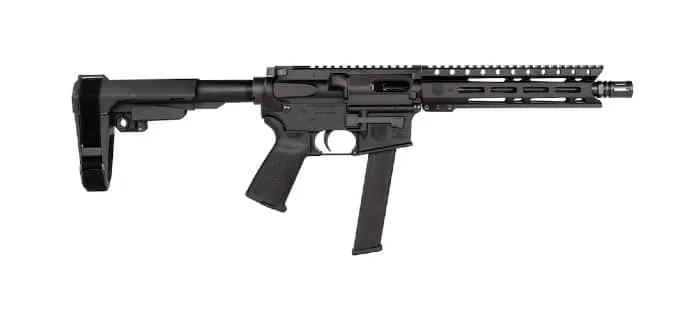
Not to be confused with the DB9 pistol, the Diamondback DB9R series of rifles are an entirely different animal. These AR-style pistol caliber carbines run 16-inch CMV barrels, use forged aluminum receivers, a Mil-Spec trigger pack, and accept Glock-pattern 9mm double-stack mags, typically shipping with aftermarket ETS or ProMag 31/32/33-round examples of the variety.
First introduced in 2017 with a Roger’s stock, GI A2 pistol grip, and a short 9-inch KeyMod handguard, this has been updated in more recent years to a Magpul MOE stock and grip and a 15 inch M-LOK handguard.
Similarly, Diamondback has also marketed this platform as a pistol with shorty (4.5 or 7-inch) barrels with KAK flash hider cans and 6 or 9-inch handguards. Originally offered with SB Tactical SBA3 braces, these have been switched in more recent years to the Gearhead Tailhook brace.
Key Features
- Glock magazine compatibility: Use the same magazines as Glock 17/19 pistols—excellent for shooters who already own Glock pistols
- AR-15 manual of arms: Familiar controls and operation for anyone experienced with AR platforms
- Blowback operation: Simple, reliable system with fewer parts than gas-operated rifles
- Free-float M-LOK handguard: Modern mounting solutions for lights, grips, and accessories
- Magpul furniture: Stock and grip upgrades included from the factory save $60-$80 in immediate upgrades
- Mil-spec trigger compatibility: Can upgrade to any AR-15 aftermarket trigger
Best For
The DB9R excels as a home defense carbine where 9mm overpenetration concerns make .223/5.56 less ideal, a competition PCC for local matches, or a cost-effective training platform where 9mm ammunition is significantly cheaper than rifle calibers. It’s also excellent for new shooters learning rifle fundamentals with manageable recoil.
Pros
- Affordable PCC entry: At $750-$850, it’s cheaper than most name-brand pistol-caliber carbines
- Magazine versatility: If you own Glock pistols, you already have compatible magazines; high-capacity Glock magazines are affordable and widely available
- Low recoil: 9mm from a 6.5-lb carbine is extremely soft-shooting—ideal for recoil-sensitive shooters
- AR-15 compatibility: Most AR-15 parts work including stocks, grips, triggers, charging handles
Cons
- Blowback operation is heavy: Blowback bolt is significantly heavier than standard AR-15 BCG; consider upgrading to a heavier buffer spring
- ETS/ProMag included magazines: Factory-included magazines are functional but not premium quality; budget for Glock OEM magazines
- No LRBHO with Glock magazines: Last-round bolt hold open doesn’t function with standard Glock magazines unless you use PCC-specific magazines
- Limited magazine compatibility: Only accepts Glock-pattern magazines, not Colt-pattern
Who Should Buy This
Buy the DB9R if you already own Glock pistols and want magazine compatibility, need an affordable home defense carbine with less overpenetration concern than .223/5.56, or want to shoot PCC competitions without spending $1,200+ on an MPX or Stribog. It’s also excellent for introducing new shooters to rifles—the low recoil and familiar pistol caliber reduces intimidation while teaching rifle fundamentals.
Alternative Considerations
- PSA AR-V ($650-$750): Similar concept, accepts Glock magazines, slightly cheaper but comparable quality
- Ruger PC Carbine ($650-$750): Takes Ruger or Glock magazines, takedown design, proven reliability
- Foxtrot Mike FM-9 ($700-$800): Better machining quality, LRBHO functionality, slightly more expensive
Current Availability
Status: In Production – The DB9R remains in Diamondback’s catalog with current models featuring updated furniture and M-LOK handguards. Availability is good through major retailers. Pistol variants with 7-9 inch barrels and arm braces were common pre-2023 but are now less available due to ATF brace rule changes—verify legal status in your jurisdiction.
My Take: For shooters who already own Glock pistols, the DB9R makes tremendous sense as a training platform and home defense option. Sharing magazines between your pistol and carbine simplifies logistics and reduces costs.
The blowback operation is simple and reliable, though the heavy bolt means the gun feels different than a traditional AR-15. At $750-$850, it’s priced competitively against comparable PCCs from PSA and Foxtrot Mike.
I’d recommend budgeting another $100 for a few Glock OEM magazines (the included ETS/ProMag magazines work but aren’t as reliable) and potentially a heavier buffer spring to smooth out the blowback impulse. With those minor upgrades, you have a reliable, fun-to-shoot PCC for less than $1,000 total investment.
6. Diamondback DB10
$1326.99

44
EXCEPTIONAL
2026 Awards & Rankings
Performance Scores
Other Sellers:
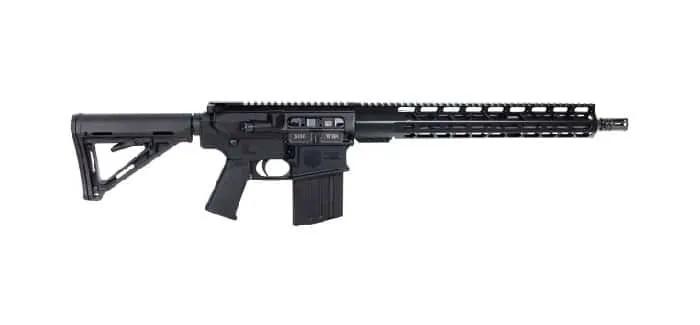
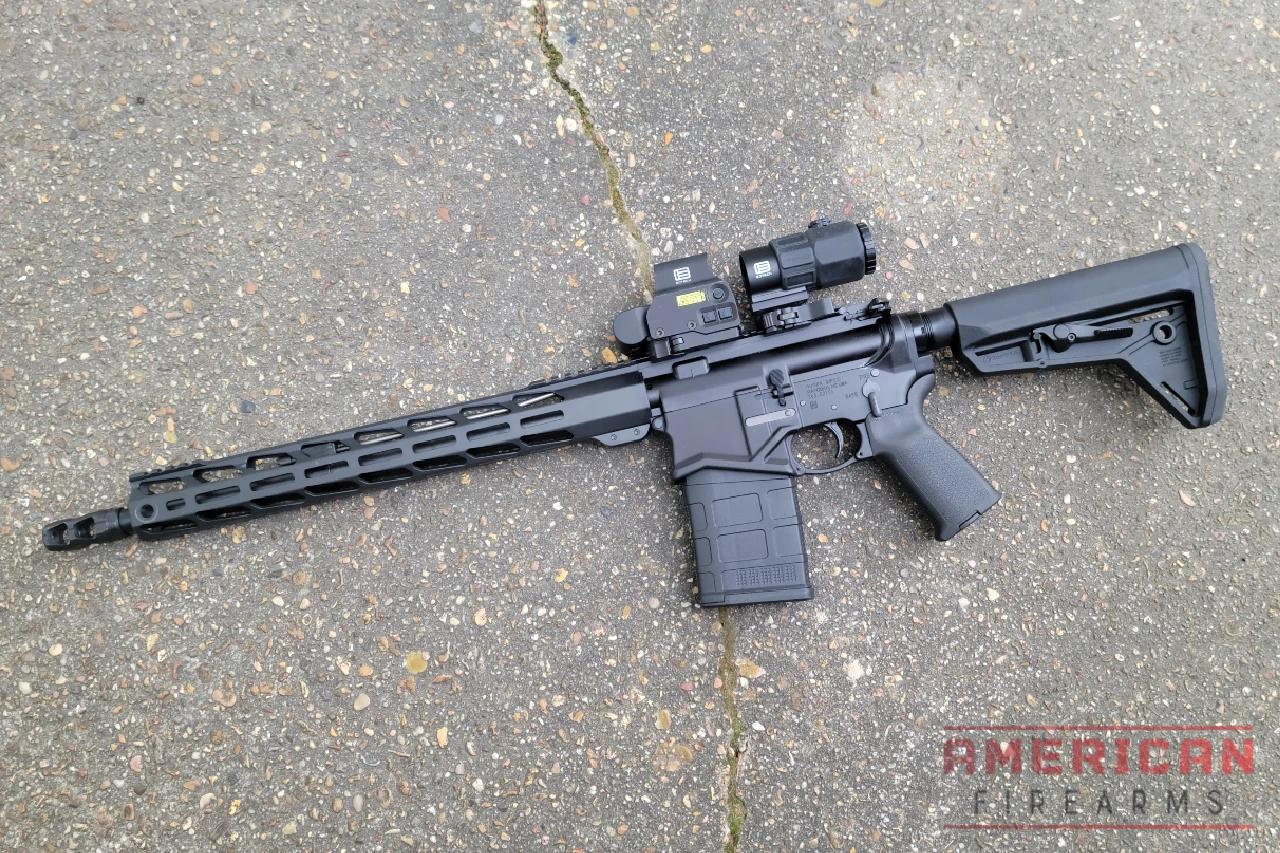
The logical step up from making AR-15s, Diamondback pocketed their experience with Eugene Stoner’s .223 platform and went .308, producing an AR-10 style rifle with an 18-inch heavy barrel with a black nitride finish, machine billet lower, Odin KeyMod rail, and a Magpul ACS stock.
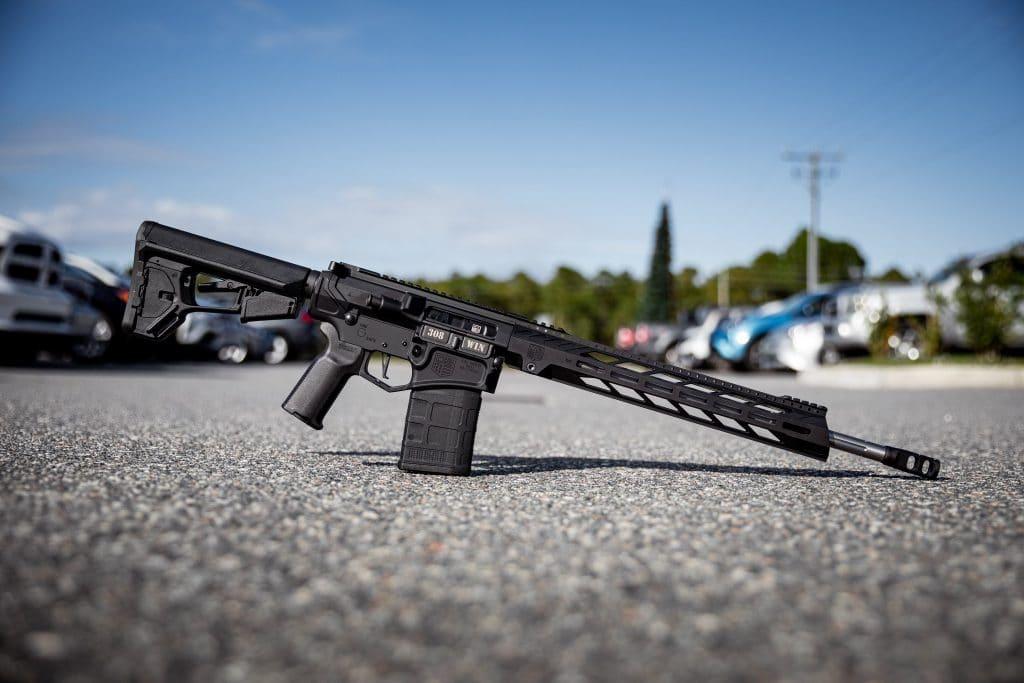
Since then, at least seven different models of the DB10 followed including variants with stainless steel fluted barrels, carbines with 16-inch barrels, dropping KeyMod for M-LOK, a precision rifle with a PRS stock, and CMC trigger, and even a 6.5 Creedmoor (the DB1065) model.
As far as compatibility goes, the DB10 accepts SR-25 style mags (shipping with Gen M3 PMAG 20-rounders), has the current AR-10 receiver cut, and DPMS AR-308 style threads when it comes to handguards. The brakes are on 5/8×24 TPI threads for those who want to add a can, and they run on mil-spec AR trigger packs.
DB10P pistol models, while heavy (we are talking 9-pound handguns here) are also extremely popular as Diamondback is one of the few players in the shorty .308 game. The current DB10 format includes a 13.5-inch medium profile 4150 CrMov barrel with a hefty muzzle brake guaranteed to make you friends at the range and a Gearhead Tailhook brake.
Key Features
- Billet machined lower receiver: Superior aesthetics and tighter tolerances than forged lowers on most budget AR-10s
- SR-25 magazine compatibility: Uses the more common magazine pattern; Magpul PMAGs are affordable and widely available
- Multiple barrel options: 16-inch carbine, 18-inch standard, 20-inch precision, stainless steel fluted variants
- Magpul furniture included: ACS stock and MOE grip come standard, saving $100+ versus bare rifles
- Mil-spec trigger compatibility: Can upgrade to any AR-15 aftermarket trigger
- 5/8×24 TPI muzzle threads: Standard .308 threading for brakes, flash hiders, and suppressors
Best For
The DB10 is ideal for hunters who need .308 range and power without spending $2,000+ on premium AR-10 platforms, recreational shooters who want affordable large-frame AR experience, or long-range enthusiasts on a budget who can accept 1.5-2 MOA accuracy rather than match-grade precision.
Pros
- Excellent price-to-performance: At $1,200-$1,400, it significantly undercuts Aero Precision M5 ($1,600+) while delivering hunting-grade accuracy
- Proven accuracy: My testing showed consistent 1.5-2 MOA with Federal Gold Medal Match—more than adequate for hunting or recreational shooting
- Billet lower aesthetics: Machined lower looks and feels more premium than competitors’ forged receivers
- Included quality furniture: Magpul components from the factory save immediate upgrade costs
- Multiple caliber options: .308, 6.5 Creedmoor variants available for different applications
Cons
- Heavy: At 9-10 lbs before optics and loaded magazine, it’s not a lightweight platform—closer to 12+ lbs ready to hunt
- Not match-grade accuracy: 1.5-2 MOA is good for hunting, not competitive with Aero Precision M5 (1-1.5 MOA) for precision work
- Limited aftermarket compared to AR-15: Fewer upgrade options than AR-15 platforms, though standard AR-10 parts fit
- Gas system can be overgassed: Some users report excessive gas with factory settings; adjustable gas block is a recommended upgrade
Who Should Buy This
Buy the DB10 if you’re a hunter who needs .308 Winchester for medium to large game at 300+ yards and don’t want to spend $2,000+ on an AR-10 platform. It’s also excellent for recreational long-range shooters who want affordable .308 semi-auto capability for steel shooting.
If you’re building a precision rifle for competition or need guaranteed sub-MOA performance, spend the extra $200-$400 for an Aero Precision M5. For hunting whitetail, hogs, or antelope where 1.5-2 MOA is more than adequate, the DB10 delivers at half the cost of premium platforms.
Alternative Considerations
- PSA PA-10 ($900-$1,100): Cheaper entry point, forged receivers, 2-2.5 MOA accuracy—$200-$300 less but less refined
- Aero Precision M5 ($1,400-$1,800): Tighter tolerances, better consistency, 1-1.5 MOA accuracy—worth the premium for precision shooters
- Ruger SFAR ($1,300-$1,500): Lighter weight (7 lbs), shorter action, excellent option if weight is priority
Current Availability
Status: In Production – The DB10 continues in Diamondback’s lineup with multiple configurations available. Standard models with 18-inch barrels are well-stocked; precision variants with PRS stocks and stainless barrels have limited availability.
The 6.5 Creedmoor DB1065 variant is produced in smaller quantities—check with retailers for current availability. DB10 pistol variants (DB10P) with 13.5-inch barrels remain available for those wanting short-barreled .308 platforms.
My Take: After extensive testing, the DB10 occupies a sweet spot for hunters on a budget. It won’t win precision rifle competitions, but it’ll drop deer at 400 yards all day long with quality ammunition.
The billet lower is genuinely nicer than what you get from PSA, and the included Magpul furniture means you can mount an optic and go hunting without immediate upgrades. At $1,200-$1,400, it’s $200-$400 cheaper than Aero Precision while delivering hunting-adequate accuracy.
If you need a .308 semi-auto for hunting and don’t have $2,000 to spend, this is the answer. Competitive shooters or precision enthusiasts should spend more for tighter-tolerance platforms, but for 95% of hunters and recreational shooters, the DB10’s accuracy is more than sufficient.
7. Diamondback DB15
$927.99
41
EXCEPTIONAL
2026 Awards & Rankings
Performance Scores
Other Sellers:
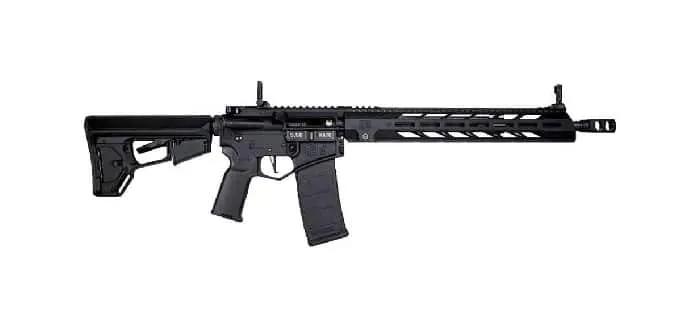
Just a couple of years after getting in the firearms game, Diamondback began making AR-15 style carbines.
Over the past decade they have branched out from the standard 5.56 NATO-chambered models to guns in .223 Rem and with .223 Wylde chambers, as well as 300 AAC Blackout (DB15300), 6.5 Grendel (DB1565G), and 7.62×39 (DB1547).
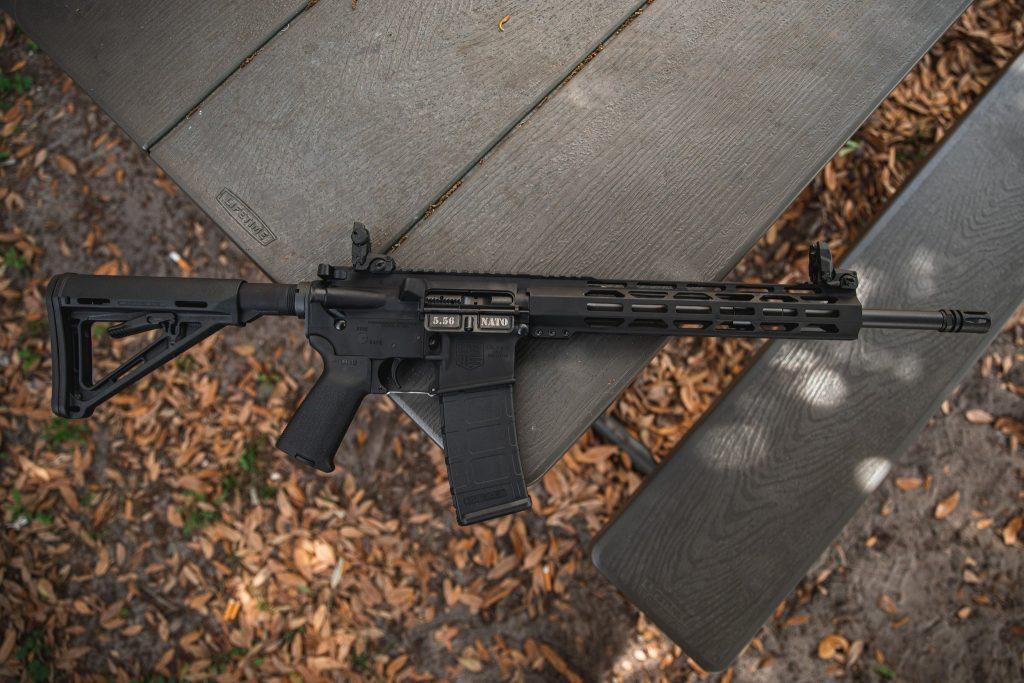
Today, the Diamondback DB15 series is available in no less than 50 models of rifles differing in caliber, barrel length (16, 18, 20), barrel contour (medium, heavy), receiver grade (Carbon, Black Gold, Diamond), handguard (M-LOK, KeyMod, A2 plastic, quad rail), stock (MOE Carbine, Magpul CTR, Magpul ACS-L, 6-Position M4 Mil-Spec, ATI), muzzle device, color, and GIO gas system (no pistons).
Currently, Diamondback uses shot-peened, magnetic particle inspected mil-spec 8620 bolt carrier groups in all its DB15 builds as well as Magpul Gen 3 PMAG magazines. Their barrels, rifled in-house, use 1:8 or 1:7 RH twists for .223/5.56 and 1:9.5 RH for 7.62x39mm.
They use T-marked A3 flat-top style uppers exclusively, keeping away from the retro A1 and A2 carrying handle crowd.
Key Features
- Three receiver tiers: Carbon Series (budget), Black Gold (mid-tier), Diamond Series (premium with enhanced trigger guard and machining)
- Shot-peened, MPI bolt carrier groups: Standard across all models ensures reliability
- In-house rifled barrels: 1:8 or 1:7 RH twist optimized for common bullet weights (55-77 grain)
- T-marked A3 flat-top uppers: Standard Picatinny rails for unlimited optics options
- Multiple caliber options: Beyond standard 5.56, available in .300 Blackout, 6.5 Grendel, 7.62×39 for specialized applications
- Mid-length gas systems: Standard on most 16″ models for softer recoil than carbine-length
- Magpul Gen 3 PMAGs included: Quality magazines from the factory
Best For
The DB15 is ideal as a first AR-15 for new shooters who want proven reliability without premium pricing, a home defense rifle that won’t break the bank, a project platform for customization (excellent base for upgrades), or a workhorse rifle for training and recreational shooting.
Receiver Grade Breakdown
Carbon Series ($550-$700):
- Standard trigger guard
- Basic machining and finish
- All mil-spec compatibility
- Best pure value option
Black Gold Series ($650-$800):
- Enhanced trigger guard
- Improved machining details
- Typically includes better furniture
- Moderate price increase over Carbon
Diamond Series ($850-$1,100):
- Premium trigger guard and machining
- CMC 3.5 lb single-stage trigger included
- Magpul ACS-L stock and MOE grip
- Hard case and folding sights included
- Best all-around package
Pros
- Exceptional value: Hard to beat the DB15’s combination of quality and price in the $650-$750 range
- Proven reliability: My 1,500+ round test across multiple DB15s showed 0-2 malfunctions total
- Tight receiver fit: Upper-to-lower fit is tighter than PSA, Anderson, or most budget competitors
- Mid-length gas standard: Softer recoil and less gas in the face than carbine-length competitors
- Real mil-spec compatibility: All standard AR-15 parts fit and function
- American-made with vertical integration: Barrels, receivers, rails made in-house in Florida
- Flared magazine well: Genuinely useful feature for faster reloads (Diamond Series)
Cons
- Trigger is basic mil-spec: Serviceable but not great on Carbon/Black Gold models—budget $150-$200 for CMC or LaRue upgrade, or buy Diamond Series
- Finish inconsistency: Anodizing can vary slightly between upper and lower receivers
- Limited name recognition: Less resale value than established brands like Colt, BCM, or Daniel Defense
- Keymod on older models: Early models used KeyMod instead of more popular M-LOK (current models are M-LOK)
Who Should Buy This
Buy the DB15 if you’re a first-time AR buyer who wants a reliable, well-built rifle without spending $1,200+ on premium brands.
It’s also excellent for experienced shooters who want a project platform to customize—the solid foundation of quality receivers and barrel means you can upgrade furniture, triggers, and handguards as budget allows. For home defense, training, or recreational shooting where you need proven reliability at an accessible price point, the DB15 delivers.
The Diamond Series specifically is my top recommendation for new AR buyers who can stretch the budget to $900-$1,000—the included CMC trigger, quality furniture, and case make it a complete package.
Alternative Considerations
- PSA PA-15 ($550-$750): More configuration options, frequent sales, forged receivers, comparable reliability
- Anderson AM-15 ($450-$550): Cheapest entry to AR ownership, basic mil-spec build, less refined than DB15
- Ruger AR-556 ($700-$800): Established brand name, proven reliability, slightly more expensive
- Radical RF-15 ($600-$750): Similar features and pricing, comparable quality
Current Availability
Status: In Production – The DB15 remains Diamondback’s flagship product line with robust availability across all series. Carbon Series models are consistently in stock at major retailers.
Black Gold and Diamond Series have more limited availability but are regularly produced. Specialty calibers (.300 Blackout, 6.5 Grendel, 7.62×39) have smaller production runs—check with retailers for current availability.
Most models now feature M-LOK handguards rather than older KeyMod designs.
My Take: After testing multiple DB15 configurations over several years and several thousand rounds, I genuinely recommend these rifles to new AR buyers without hesitation.
The machining quality exceeds what you get from PSA or Anderson, the reliability matches rifles costing twice as much, and the mid-length gas system makes them noticeably more pleasant to shoot than carbine-length competitors.
At $650-$750 for a Carbon or Black Gold model, you’re getting excellent value. If budget allows, the Diamond Series at $900-$1,000 is the best complete package in the budget AR market—the CMC trigger alone is worth $170, and you get a hard case and backup sights included.
These aren’t Daniel Defense or BCM quality, but they’re well-built, reliable rifles that will serve faithfully for home defense, training, or recreation. I’d buy another DB15 without hesitation.
8. Diamondback’s DB15 Pistol Line
$932
33
AVERAGE
2026 Awards & Rankings
Performance Scores
Other Sellers:
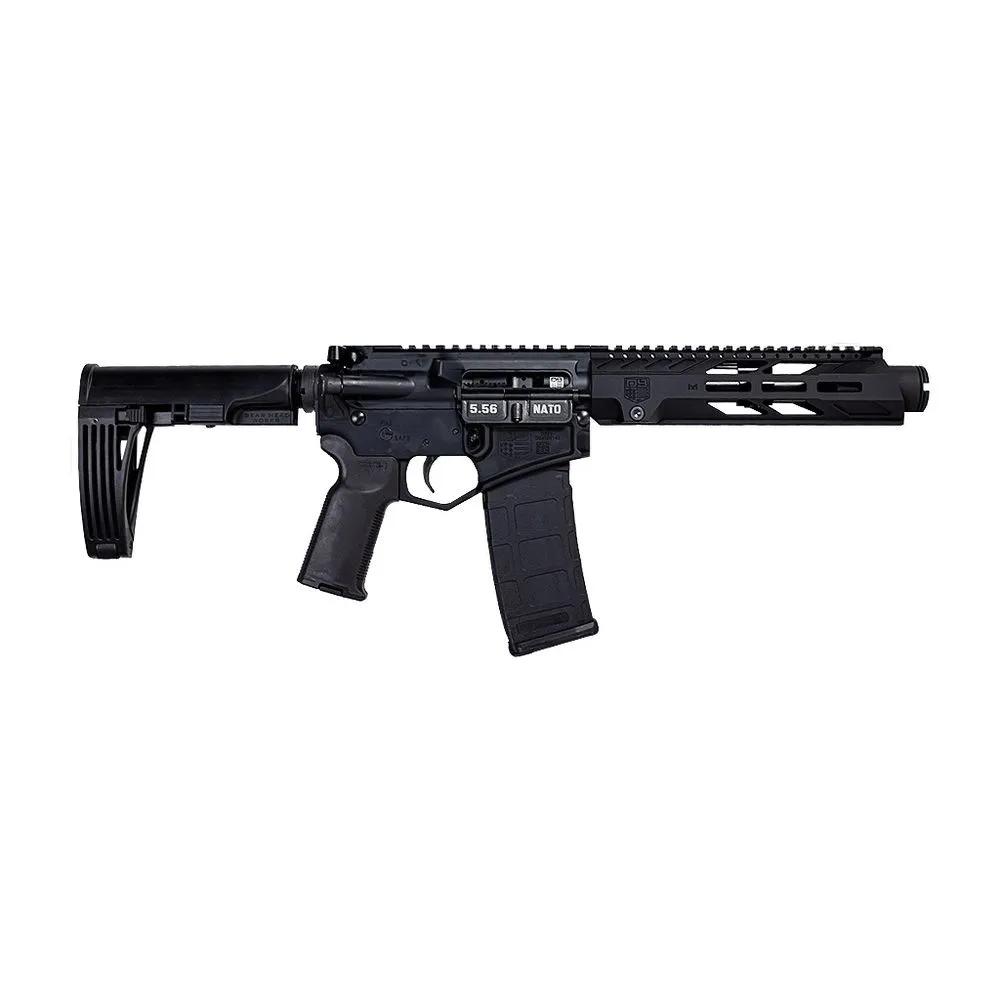
Starting in 2014, just months after the SB Tactical brace hit the market, Diamondback began aggressively marketing DB15 series AR pistols.
As with their carbines, they exclusively use forged aluminum A3 flat-top upper and lower receivers coupled with gas impingement operation systems, usually of pistol-length, and either 10.5, 8.5, or 7-inch CM barrels.
Over the years, Diamondback has introduced DB15P models in 5.56 NATO, .223 Rem, .300 BLK, and 7.62×39 with a variety of brace styles (SB Tactical, Gearhead Worx, and Maxim) or the more-ATF friendly buffer tube foam pad.
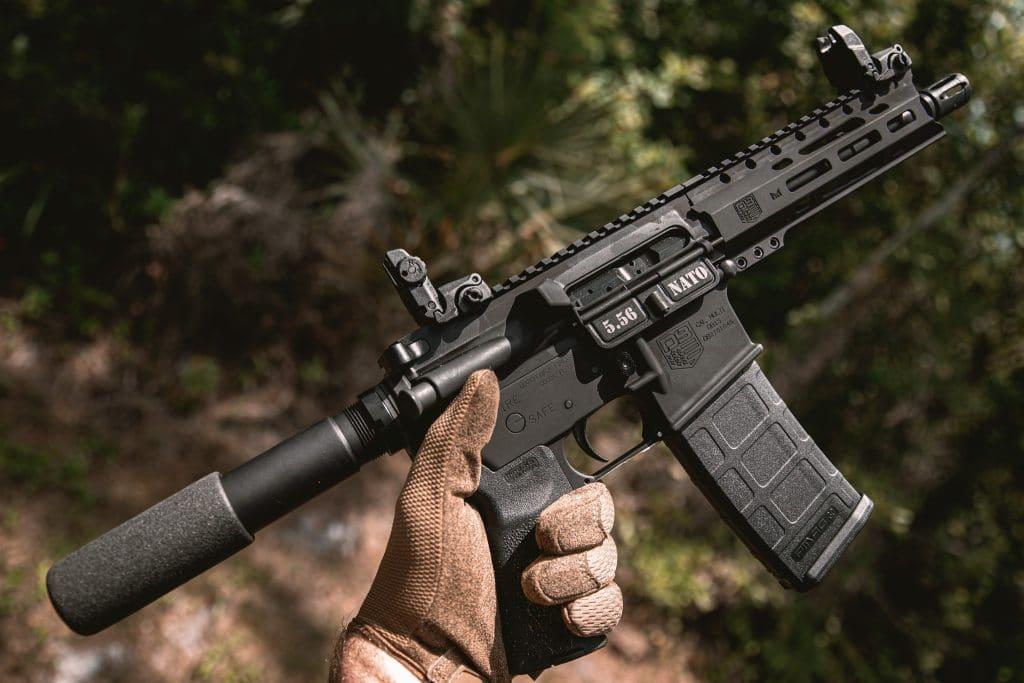
Handy guns, these have proved extremely popular for those looking for a compact home defense or hunting option.
Using standard 1/2 x 28TPI threads, they are suppressor-ready. Diamondback currently catalogs more than 20 DB15P models.
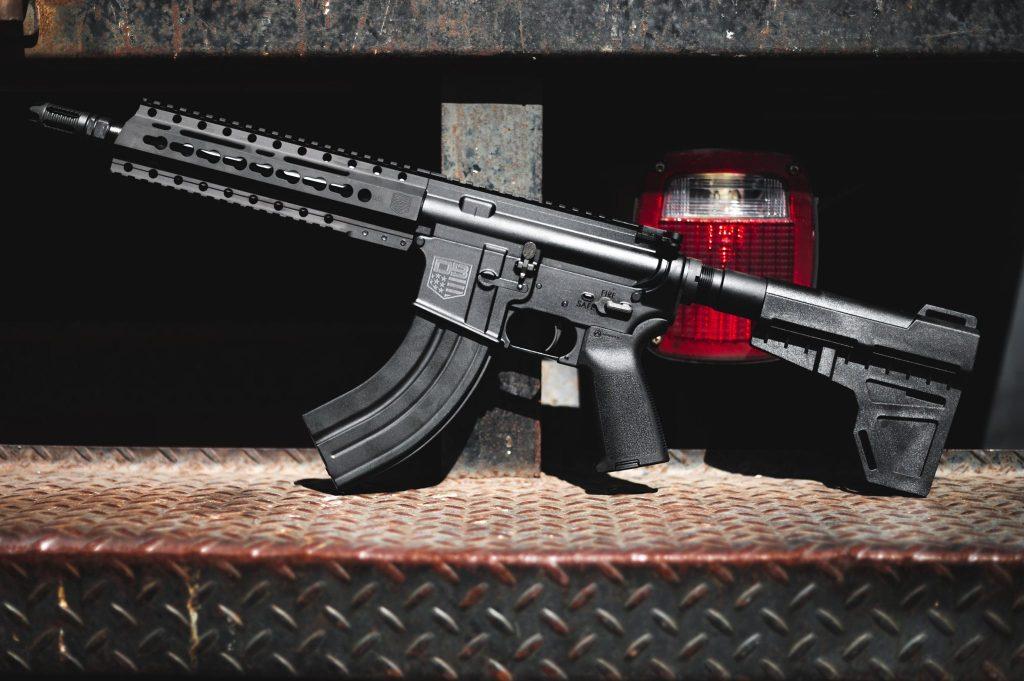
The ATF’s final pistol brace rule, published in January 2023, fundamentally changed the AR pistol market. Pistols equipped with braces were classified as short-barreled rifles (SBRs) requiring NFA registration, but as of 2025, the ATF’s pistol brace rule from 2023 has been vacated in federal courts.
Current Diamondback DB15P models are available with buffer tube foam pads or as registered SBRs. Verify your state and local laws before purchasing any AR pistol configuration.
Key Features (Post-2023 Brace Rule)
- Multiple barrel lengths: 7″, 8.5″, and 10.5″ options for different applications
- Pistol-length gas system: Optimized for short barrels, though can be overgassed
- Suppressor-ready: Standard 1/2×28 TPI threading accepts suppressors and muzzle devices
- Compact dimensions: 24-28 inches overall length makes them extremely maneuverable
- Multiple caliber options: .300 Blackout variants especially popular for suppressed use
- Current compliance options: Buffer tube foam pad (ATF compliant) or registered SBR (Form 1 approved)
Best For (Post-Brace Rule Era)
AR pistols now serve primarily as registered SBRs for those willing to complete NFA paperwork, home defense platforms where compact length is critical (using buffer tube configuration), or suppressor hosts for .300 Blackout variants. The practical use cases have narrowed significantly compared to the pre-2023 brace era.
Regulatory Status and Considerations
Critical Information for 2024-2025 Buyers:
The January 2023 ATF rule on pistol braces changed the AR pistol market fundamentally. Here’s what you need to know:
- Brace-equipped pistols: May be classified as SBRs requiring NFA registration ($200 tax stamp, Form 1 approval, potential state restrictions)
- Current Diamondback offerings: Now sold with buffer tube foam pads (no brace) or as pistols requiring buyer to complete Form 1
- State law variance: Some states prohibit SBRs entirely; verify your jurisdiction before purchase
- Grandfathered options: Pistols purchased before January 2023 had registration grace periods; consult current ATF guidance
My Recommendation: Unless you’re committed to the NFA registration process or live in an SBR-friendly state, consider a 16-inch rifle instead. The regulatory complications outweigh the modest length advantage for most users.
Pros (When Properly Configured)
- Extreme maneuverability: 24-28 inch overall length excels in vehicles or tight spaces
- Suppressor compatibility: Short barrels pair well with suppressors, especially in .300 Blackout
- Home defense optimization: Compact length easier to navigate than 16-inch rifles in hallways
- Multiple caliber options: .300 Blackout variants offer subsonic suppressed capabilities
Cons
- Regulatory complexity: ATF brace rule creates legal uncertainties; NFA registration required for traditional use
- Overgassed systems: Pistol-length gas on short barrels means excessive gas without suppressor or adjustable gas block
- Concussion and flash: Short barrels produce significant muzzle blast and flash, especially with 5.56
- Limited practical advantage: Post-brace rule, a 16-inch rifle is often simpler and more practical
- Reduced velocity: 5.56 NATO loses 200-300 fps from 7-10.5 inch barrels versus 16-inch
Who Should Buy This (2024-2025)
Buy a DB15 pistol if you’re specifically building a registered SBR and want to save money versus premium manufacturers, you’re building a dedicated suppressor host in .300 Blackout, or you absolutely need compact length for vehicle-based home defense and are willing to use the buffer tube configuration. For most buyers, I recommend a standard 16-inch DB15 rifle instead—it avoids regulatory complications while offering better ballistic performance.
Alternative Considerations
- 16-inch DB15 rifle ($650-$750): Simpler legally, better ballistics, only 4-6 inches longer
- Ruger AR-556 pistol ($700-$800): Similar concept, established brand, same potential regulatory considerations
Current Availability
Status: Limited Production – Diamondback significantly reduced DB15P production following the 2023 brace rule, but have since picked production back up and now have a solid array available with brace-equipped models available at most retailers. .300 Blackout variants have better availability than 5.56 models. Check with FFL dealers about current legal status in your jurisdiction before purchasing.
My Take: The legal underpinnings of the AR pistol market are probably the least stable in the entire world of firearms, so I no longer recommend AR pistols with the same enthusiasm I once did, especially for new buyers.
The regulatory complications, NFA paperwork requirements, and state law variations create headaches that outweigh the modest size advantages for most users. If you’re absolutely committed to an AR pistol, the DB15P offers budget-friendly entry at $700-$900. But for 95% of buyers, I recommend a standard 16-inch DB15 rifle instead—it’s simpler legally, offers better ballistics, and costs less.
The only exception is if you’re building a dedicated .300 Blackout suppressor host—then the 8.5 or 10.5-inch .300 Blackout DB15P makes sense. Otherwise, stick with rifles.
9. Diamondback DBX57
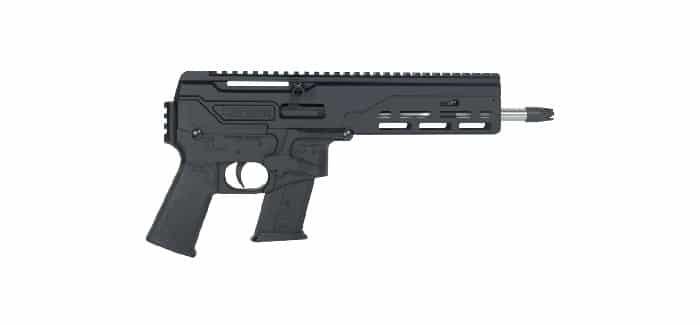
Introduced in 2020, the DBX57 appeared on the scene as 5.7x28mm was becoming more popular. Although introduced in the 1990s, only FN made guns chambered for the aggressive little round that has been characterized as a .22 Magnum on steroids.
However, as Ruger brought out the 57 pistol and CMMG introduced a Banshee model, the MK57, in the caliber, it suddenly started getting a lot of new looks. And Diamondback’s take on a gun that feeds on the 5.7 is very fresh.
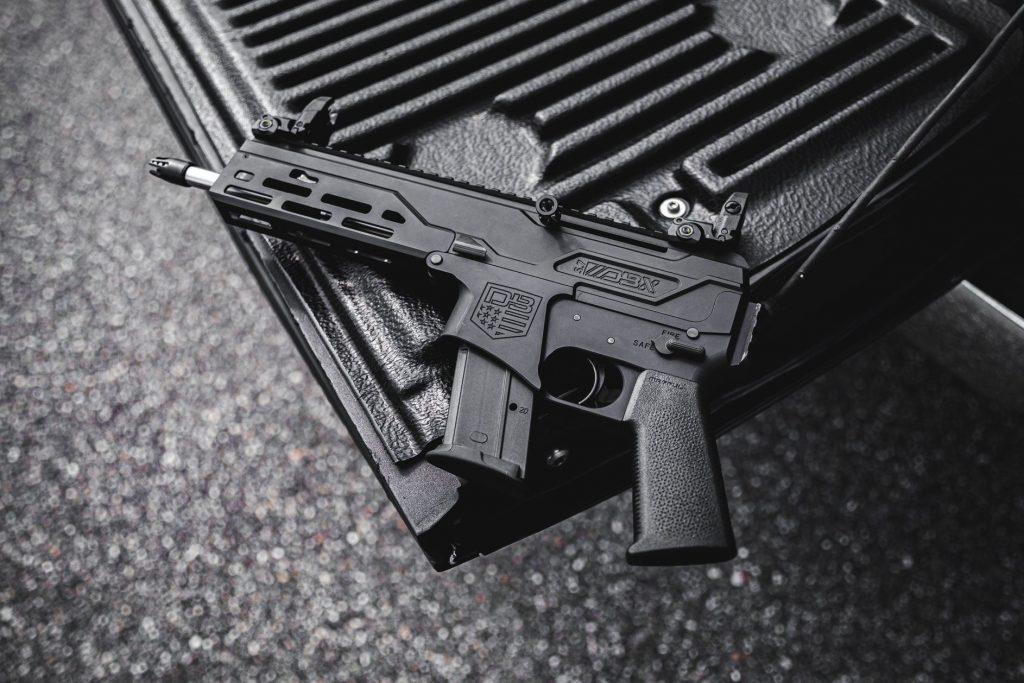
The DBX is a locked-breech, dual gas piston operation semi-auto pistol with an 8-inch barrel. Using 20/30-round FN FiveseveN pattern mags, aluminum receivers, and an AR-15 Mil-Spec trigger and AR-pattern grip, it has Picatinny rails on top for optics and in the rear of the receiver for a stabilizing brace. An M-LOK handguard allows lights, lasers, and handstops.
On the whole, this is seriously compact and only weighs about 3-pounds. With the muzzle threaded 1/2x28TPI and the gas system user-adjustable on both pistons to accommodate different loads and uncorking profiles, the DBX also makes a great suppressor host.
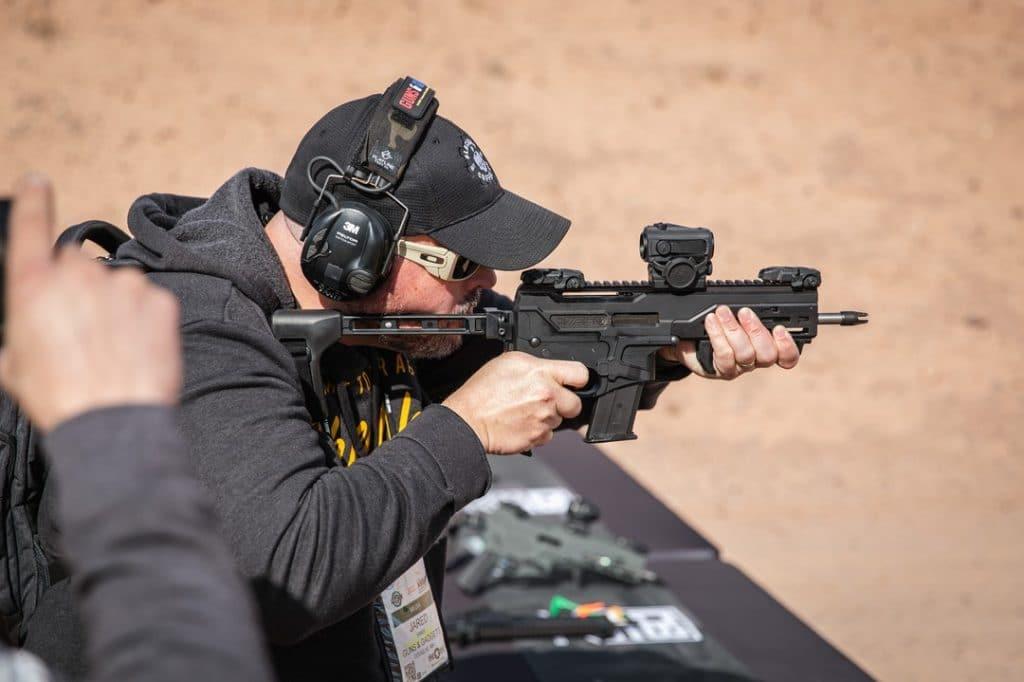
Dimensionally, it is very thin and is only 15.25-inches long in its shortest configuration, comparable to the Micro Draco. This has led many to feel the DBX is extremely well-suited for discreet trail use or in an urban environment.
Key Features
- Unique 5.7x28mm chambering: Bridges gap between pistol and rifle performance with armor-piercing capable cartridge (with appropriate ammunition)
- Extremely compact: 15.25 inches overall length makes it one of the most compact centerfire platforms available
- Lightweight: At 3 lbs unloaded, it’s lighter than most AR pistols
- Dual adjustable gas pistons: User-tunable for suppressed and unsuppressed use
- FN magazine compatibility: Uses proven FN FiveSeven magazines (20 or 30-round capacity)
- Suppressor-optimized: 1/2×28 TPI threading and adjustable gas make it excellent suppressor host
- AR-15 trigger compatibility: Can upgrade to any aftermarket AR trigger
Best For
The DBX57 excels as a vehicle gun for those who spend significant time on the road, a backpack/pack-out gun for hunters or hikers (though limited to defensive use due to 5.7x28mm ballistics), a suppressor host for those wanting quiet, flat-shooting capability, or a unique range toy for those who want something different than another AR-15.
Pros
- Truly unique platform: Nothing else quite like it on the market at this price point
- Extreme portability: 15.25 inches and 3 lbs makes it the most packable centerfire option
- High capacity: 30-round magazines in a tiny package
- Armor-piercing capability: With appropriate ammunition (SS197SR, SS198LF), 5.7x28mm can defeat soft body armor
- Low recoil: 5.7x28mm is soft-shooting, making rapid fire easy
- Suppressor-friendly: Adjustable gas and 5.7x28mm cartridge characteristics make it excellent suppressed
- Innovative design: Dual gas piston system is clever engineering
Cons
- Limited ammunition selection: 5.7x28mm is expensive ($0.60-$1.00+ per round) and less available than common calibers
- Questionable terminal ballistics: 5.7x28mm’s effectiveness on soft targets is debated; primarily anti-personnel/barrier cartridge
- Expensive: At $1,000-$1,200, it costs significantly more than comparable 9mm PCCs or AR pistols
- Niche use case: Hard to justify for most users over a 9mm PCC or .300 Blackout AR pistol
- Magazine cost: FN magazines are $40-$50 each
- Regulatory uncertainty: Same brace-related concerns as other AR pistols post-2023
Who Should Buy This
Buy the DBX57 if you’re specifically seeking a compact, high-capacity platform for vehicle carry where 5.7x28mm’s barrier-penetration capabilities are valued, you want an ultralight backpack gun for wilderness carry (bears excepted), you’re building a dedicated suppressed platform and want something unique, or you simply want the most interesting gun at the range.
This isn’t a practical first gun—it’s a specialized tool or enthusiast piece.
Alternative Considerations
- CMMG Banshee MK57 ($1,400-$1,600): More refined, better trigger, AR-pattern controls, $300+ more expensive
- Ruger-57 pistol ($600-$700): If you just want 5.7x28mm in a pistol format, much cheaper
- PSA AR-V 9mm ($650-$750): More practical for most users, cheaper ammunition, comparable compactness
Current Availability (2024-2025)
Status: In Production – The DBX57 continues in Diamondback’s catalog though production volumes are lower than DB15/DB10 due to niche appeal. Availability fluctuates; expect to wait or backorder through dealers.
The unique 5.7x28mm chambering means it faces less competition in the market.
My Take: The DBX57 is the gun I wanted to love more than I actually do. It’s genuinely clever engineering, extremely compact, and fun to shoot. But 5.7x28mm ammunition costs $0.60-$1.00+ per round, and the terminal ballistics on soft targets are questionable compared to 9mm or .300 Blackout.
At $1,000-$1,200, it’s expensive for what amounts to a range toy or very specialized vehicle gun. If you’re absolutely committed to 5.7x28mm and want maximum compactness, it’s the most affordable option in this niche. But for most users, a 9mm PCC like the DB9R or a .300 Blackout AR pistol makes more practical sense. I keep coming back to the same question: what problem does the DBX57 solve that a 9mm PCC or .300 Blackout AR doesn’t solve better and cheaper?
The answer is “ultimate compactness with barrier penetration,” which is a very narrow niche. Buy it if that’s specifically what you need, or if you just think it’s cool (which is a legitimate reason). Otherwise, there are more practical options.
10. Diamondback Sidekick
$236
31
AVERAGE
2026 Awards & Rankings
Performance Scores
Other Sellers:
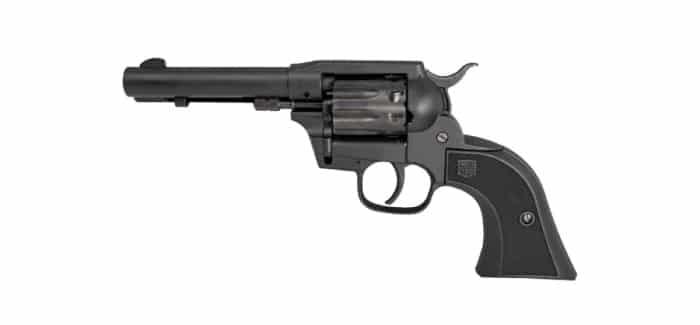
In 2021, Diamondback stretched its comfort zone once again and moved into the rimfire market and revolver market at the same time by introducing the Sidekick.
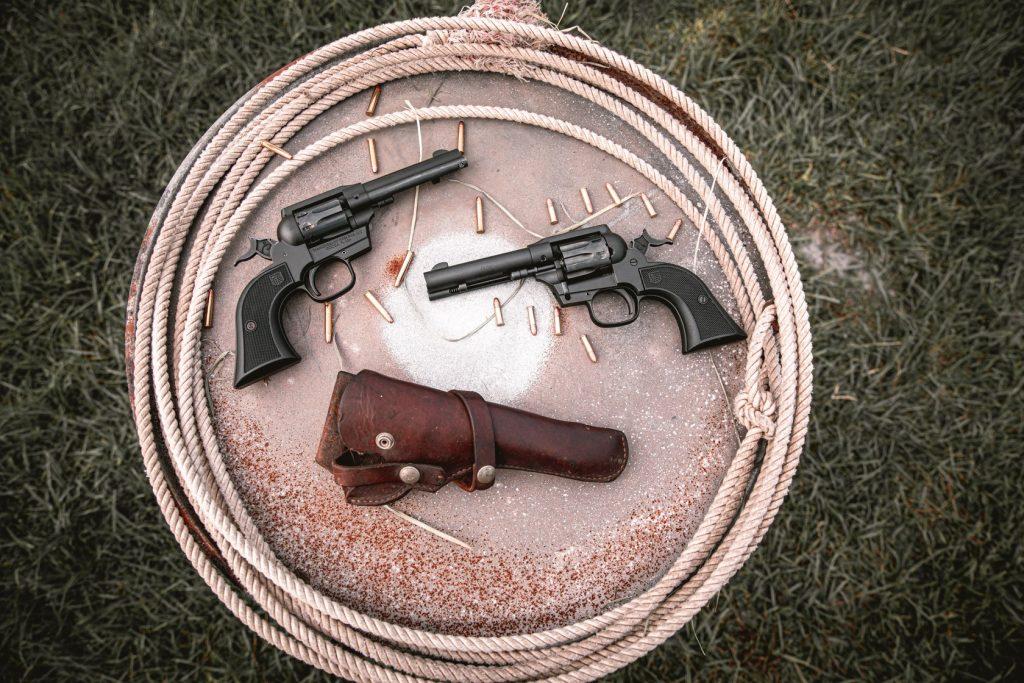
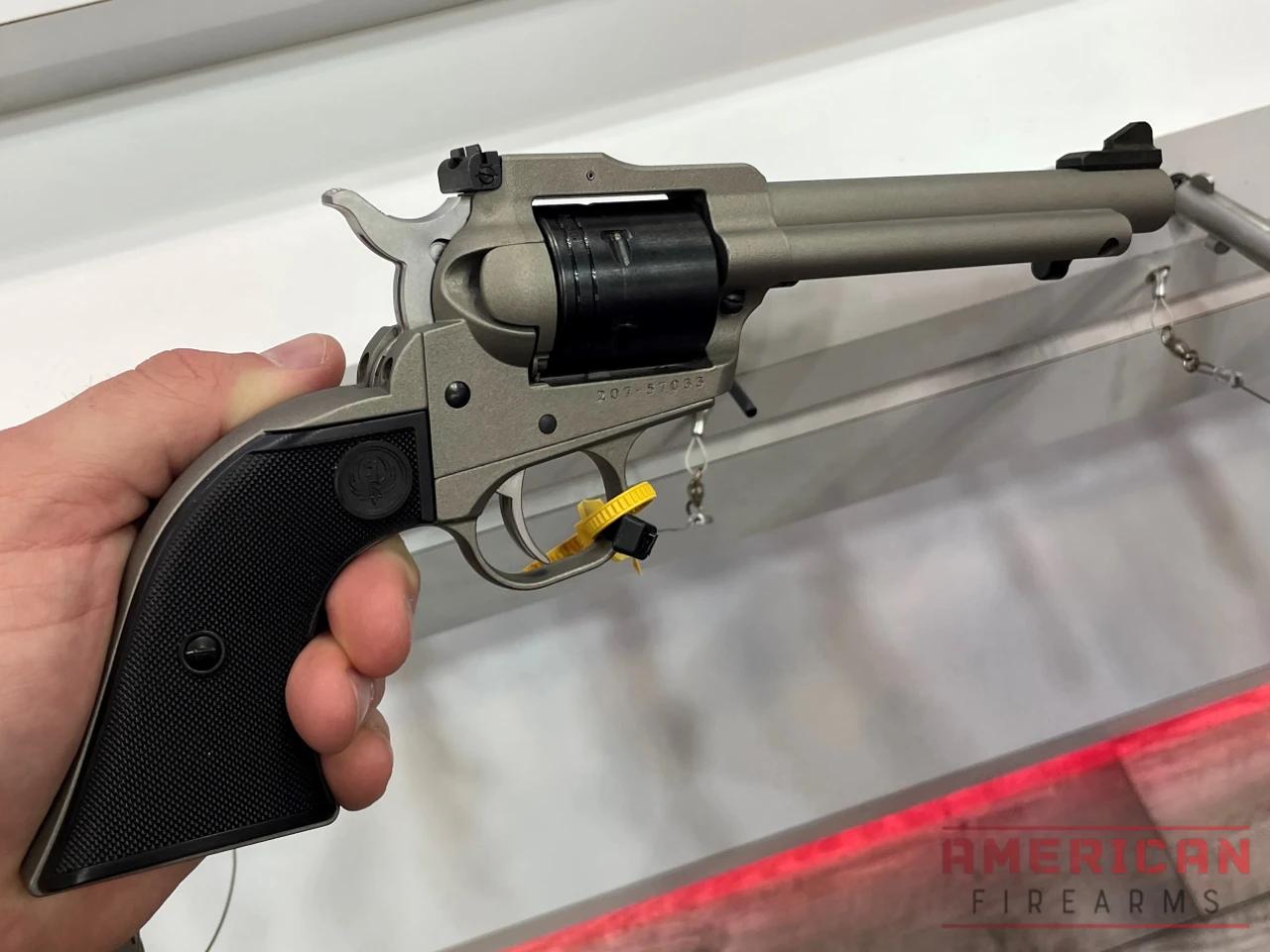
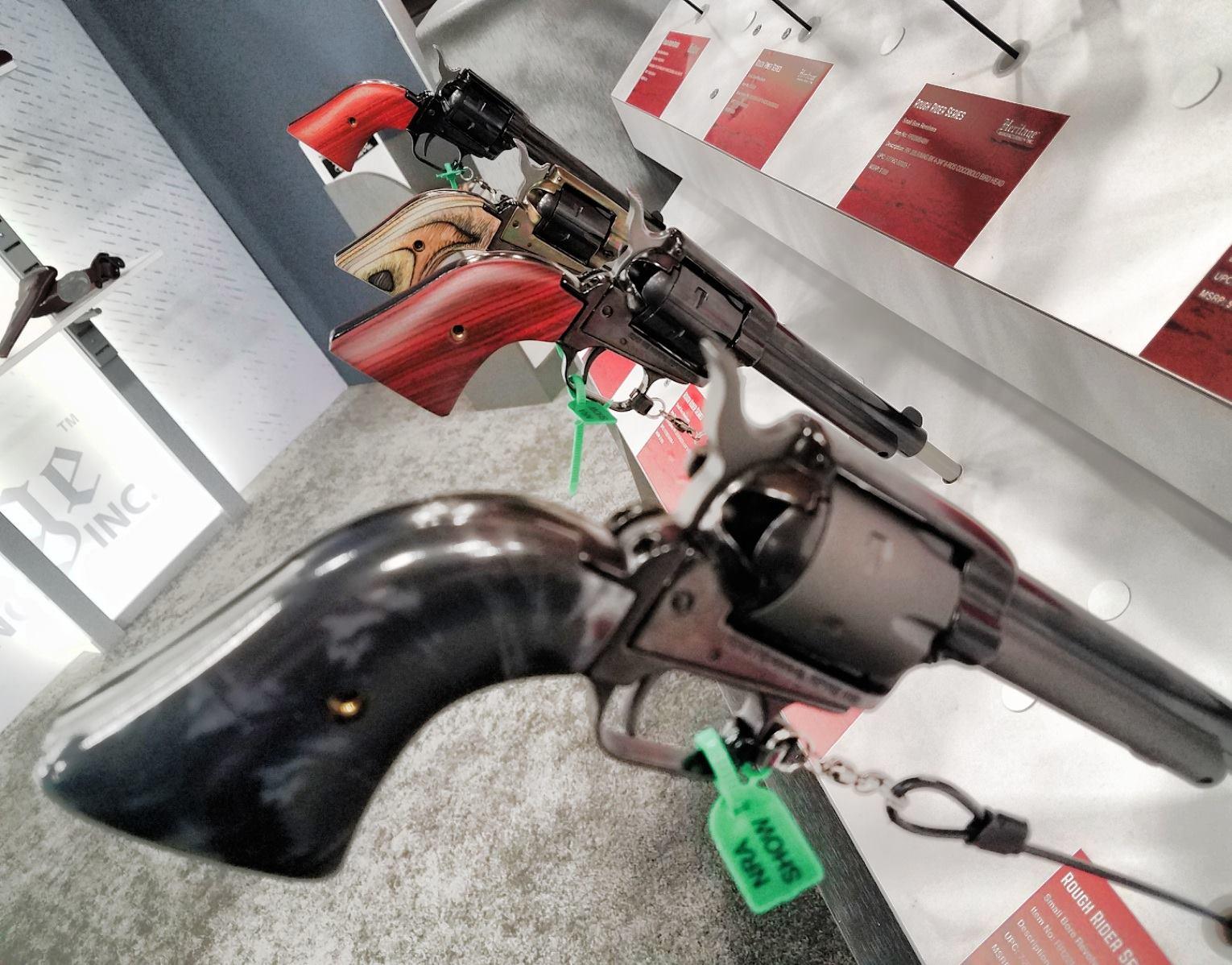
Although it looks like a single-action .22 revolver akin to the Ruger Bearcat/Wrangler or Heritage Rough Rider, the Sidekick is just styled to bring in those who like cowboy guns and is actually a double-action revolver with a 9-shot cylinder that kicks out (get the name now?) to the left for loading and reloading.
Further, it is convertible and can move between .22LR and .22WMR cylinders, with the user able to easily swap them out in seconds. Using a 4.5-inch 6 groove barrel, it is accurate despite the fixed blade front integral rear groove sight.
Fitted with a basic checkered glass-filled nylon grip and a black Cerakote finish over the budget Zamak frame, it weighs 32.5-ounces, which just soaks up recoil.
Key Features
- Convertible cylinder system: Swap between .22 LR and .22 WMR in seconds—no tools required
- 9-shot capacity: One more round than most competitive .22 revolvers
- Double-action trigger: Unlike most cowboy-styled .22s, you can fire double-action or cock the hammer for single-action
- Modern swing-out cylinder: Left-side ejection is faster than loading gate designs on Heritage or Ruger Wrangler
- Budget-friendly: At $220-$260, it’s priced competitively with Heritage Rough Rider but offers more versatility
Best For
The Sidekick is ideal as an affordable plinker for casual shooting fun, a camping/trail gun for small game or pests, a learning platform for new shooters (low recoil, simple operation), or a fun gun for those who want cowboy aesthetics with modern DA/SA functionality and dual-caliber capability.
Pros
- Dual-caliber versatility: .22 LR for cheap practice, .22 WMR for better terminal performance—one gun, two uses
- Double-action capable: Unlike Heritage Rough Rider or Wrangler, can be fired without cocking hammer
- 9-shot capacity: More rounds than 6-shot competitors
- Modern ejection: Swing-out cylinder is faster to reload than loading gates
- Affordable: $220-$260 gets you both cylinders included
- Heavy enough to soak recoil: 32.5 ounces makes .22 recoil negligible
Cons
- Zamak frame: Not steel like Ruger or S&W; Zamak is strong enough for .22 but less durable long-term
- Basic sights: Fixed blade front and groove rear work but aren’t adjustable
- Weight: 32.5 ounces is heavy for a .22 revolver—fine for plinking, but a lot for trail carry
- Cylinder swap reset: Swapping cylinders can occasionally require timing adjustment; not always drop-in perfect
Who Should Buy This
Buy the Sidekick if you want an affordable, fun .22 revolver that offers more versatility than Heritage or Wrangler clones, you want to try both .22 LR and .22 WMR without buying separate guns, you’re teaching new shooters and want DA/SA functionality to demonstrate trigger operation, or you simply think it’s a cool, fun gun (which it is).
This isn’t a serious defensive revolver or precision target gun—it’s a fun, affordable plinker with unique versatility.
Alternative Considerations
- Heritage Rough Rider ($150-$200): Cheaper, single-action only, loading gate design, steel frame, proven platform
- Ruger Wrangler ($200-$250): Better build quality, single-action only, traditional cowboy styling, excellent reliability
- Ruger LCRx .22 LR ($550-$650): If you want a serious .22 revolver, significantly more expensive but much better quality
Current Availability (2024-2025)
Status: In Production – The Sidekick continues in Diamondback’s catalog with good availability. Originally announced in .17 HMR and .22 WMR variants beyond the base .22 LR model, production has focused primarily on the .22 LR/.22 WMR convertible version.
Availability is solid through major retailers, though not as widely stocked as more popular models. The unique convertible-cylinder feature gives it shelf appeal even in crowded .22 revolver markets.
My Take: The Sidekick is more fun than it has any right to be at $220-$260. Yes, the Zamak frame means it won’t outlast a Ruger, and yes, the sights are basic. But for plinking, teaching new shooters, or just having fun at the range, it delivers.
The convertible cylinder is genuinely useful—shoot cheap .22 LR for practice, then swap to .22 WMR for better terminal performance on small game or pests. The double-action capability sets it apart from Heritage Rough Rider and Ruger Wrangler single-action-only designs.
At $220-$260, it’s not competing with serious revolvers—it’s competing with other budget plinkers, and in that category, the dual-caliber versatility and DA/SA trigger make it interesting. If you want a cheap, fun .22 revolver that’s a little different than the usual Heritage or Ruger options, the Sidekick delivers. Just understand what you’re buying—it’s a fun gun, not a lifetime heirloom.
11. Diamondback 1911s
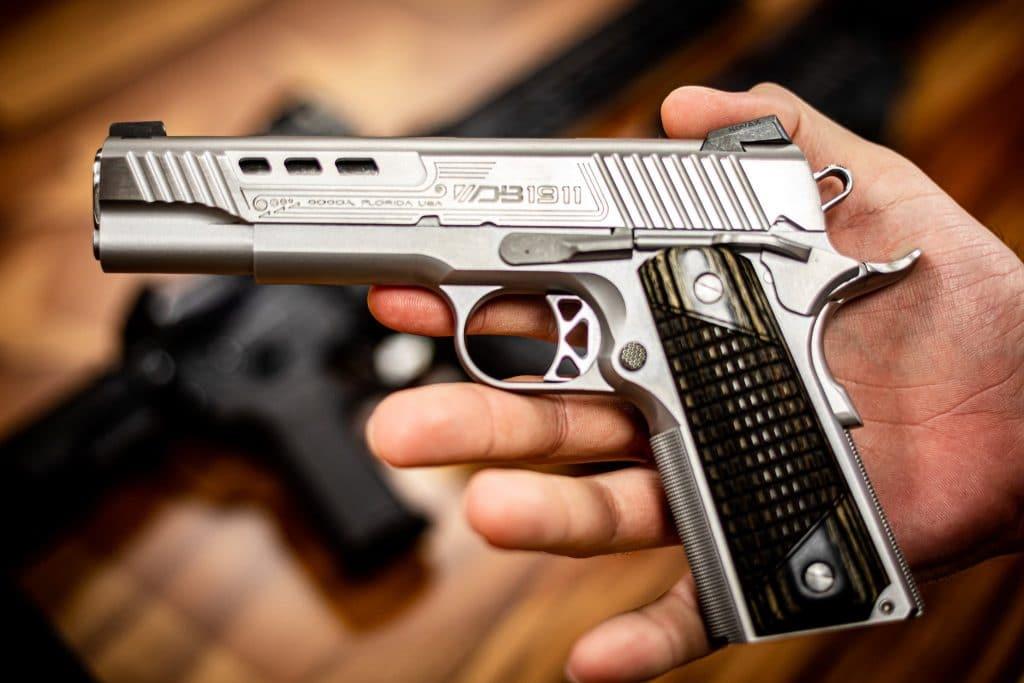
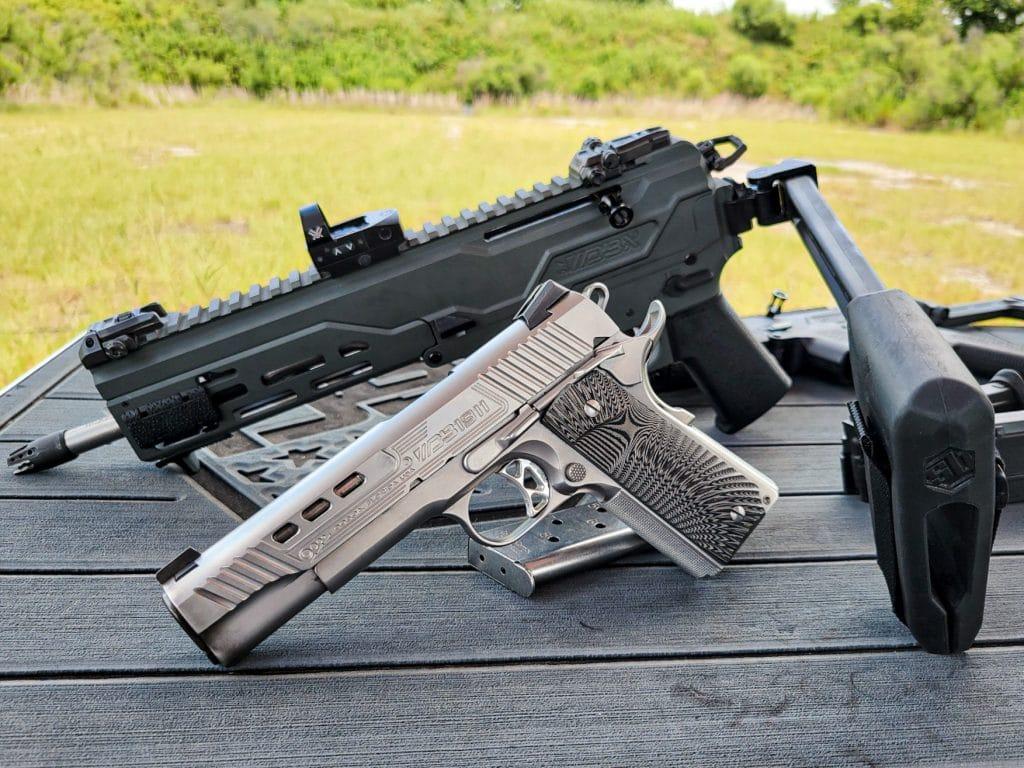
Because it is just the American thing to do, Diamondback has been talking quietly about introducing a line of 1911-style single-action pistols.
The company has brought one to SHOT Show, complete with a stylized slide with lightening cuts, a skeletonized trigger, ring hammer, Novak combat sights, G10 ergo grips, an extended beavertail grip and surface controls, and a flat mainspring housing.
No details on caliber(s) and price are available yet, but the company says they plan to announce the DB1911 is ready to ship sometime in 2022.
Diamondback vs. Competitors
When I’m asked whether Diamondback firearms are worth buying, the real question isn’t whether they’re “good” in isolation—it’s whether they’re the right choice compared to other options at similar price points.
After testing platforms from Palmetto State Armory, Anderson Manufacturing, Radical Firearms, Ruger, Smith & Wesson, and others, I can provide direct comparisons that cut through the marketing noise.
Budget AR-15 Platforms: The Real Competition
The sub-$800 AR-15 market is crowded, and Diamondback’s DB15 series faces stiff competition from established budget brands. Here’s how they actually stack up after hands-on testing.
DB15 vs. PSA PA-15 vs. Anderson AM-15 vs. Radical RF-15
| Feature | Diamondback DB15 | PSA PA-15 | Anderson AM-15 | Radical RF-15 |
|---|---|---|---|---|
Street Price | $650-$750 | $550-$650 | $450-$550 | $600-$700 |
Barrel | 4150 CrMoV Nitride | 4150 CrMoV Nitride | 4140 Chrome-lined | 4150 CrMoV Melonite |
BCG | Shot-peened MPI | Carpenter 158 MPI | Standard Mil-Spec | Shot-peened MPI |
Handguard | 15" M-LOK Free-Float | Varies by model | Carbine-length Plastic | 15" M-LOK Free-Float |
Furniture | Varies (Magpul on Diamond) | Magpul on Premium | Standard Mil-Spec | Magpul MOE |
Gas System | Mid-length | Carbine or Mid | Carbine | Mid-length |
Warranty | Limited Lifetime | Lifetime | Limited Lifetime | Lifetime |
Tested Accuracy (100 yards) | 2-3 MOA | 2-3 MOA | 3-4 MOA | 2.5-3.5 MOA |
Malfunctions (1000 rounds) | 0-2 | 0-3 | 2-5 | 1-3 |
My Take on the DB15:
The Diamondback DB15 sits in the sweet spot between PSA’s value-maximizing approach and Radical’s feature-focused builds. In my testing, the DB15 matched or exceeded PSA’s reliability while offering better out-of-box features than Anderson’s bare-bones approach. The mid-length gas system—standard across most DB15 models—delivers noticeably softer recoil than carbine-length systems on comparable PSA and Anderson rifles.
Where Diamondback pulls ahead is machining quality. The receiver fit on my DB15 Diamond Series was tighter than any PSA I’ve tested, with minimal play between upper and lower. The flared magazine well is a genuinely useful feature that speeds reloads, something you won’t find on Anderson or most PSA builds.
The nitride barrel finish has proven more durable than the Melonite on my Radical test rifle, showing less wear after 2,000+ rounds.
Where Diamondback falls short is price-to-features ratio at the entry level. Anderson beats them on pure affordability, and PSA frequently runs sales that undercut Diamondback’s street prices.
If you’re building on an absolute shoestring budget, Anderson gets you into the AR platform for $100-$200 less. But for the extra money, the DB15 delivers measurably better components—I’d take the DB15’s shot-peened, MPI bolt carrier group over Anderson’s standard mil-spec BCG every time.
Best Choice By Use:
- Absolute Budget ($450-$550): Anderson AM-15—gets you in the door, fully upgradable later
- Best Value ($650-$750): Diamondback DB15—superior machining and features justify the premium
- Maximum Features ($700-$800): PSA Premium or Radical RF-15—more furniture options and configurations
- First AR Purchase: Diamondback DB15 Carbon or Black Gold—reliable, well-built, won’t need immediate upgrades
AR-10 / .308 Platforms: Premium Performance on a Budget
The large-frame AR market traditionally costs $1,200-$2,000+, making Diamondback’s sub-$1,400 DB10 an interesting proposition against limited competition.
DB10 vs. PSA PA-10 vs. Aero Precision M5
| Feature | Diamondback DB10 | PSA PA-10 | Aero Precision M5 |
|---|---|---|---|
Street Price | $1200-$1400 | $900-$1100 | $1400-$1600 |
Receiver Type | DPMS Pattern | DPMS Pattern | DPMS Pattern |
Barrel | 18" 4150 CrMoV | 18" 4150 Nitride | 18" 416R Stainless |
Handguard | 15" M-LOK | 15" M-LOK | 15" M-LOK |
Magazine Compatibility | SR-25 (PMAG 20) | SR-25 (PMAG 20) | SR-25 (PMAG 20) |
Weight | 9.2 lbs | 9.5 lbs | 8.8 lbs |
Tested Accuracy (100 yards) | 1.5-2 MOA | 2-2.5 MOA | 1-1.5 MOA |
The DB10 occupies an interesting middle ground. It can’t match Aero Precision’s machining refinement or consistent sub-MOA accuracy, but it costs $200-$400 less depending on configuration.
Against PSA’s PA-10, the Diamondback offers noticeably better accuracy—my DB10 consistently shot 1.5-2 MOA with Federal Gold Medal Match, while the PA-10 hovered around 2-2.5 MOA with the same ammunition.
The DB10’s machined billet lower is genuinely nicer than the forged receivers on most PSA builds, and the included Magpul furniture saves $100+ in immediate upgrades.
For hunters or recreational shooters who need .308 performance without match-rifle precision, the DB10 delivers. Competitive shooters or serious precision enthusiasts should spend the extra $200-$300 for Aero Precision’s tighter tolerances.
Best Choice By Use:
- Budget .308 Entry ($900-$1,100): PSA PA-10—functional, reliable, upgradable
- Hunting/Recreational ($1,200-$1,400): Diamondback DB10—excellent accuracy for the price
- Precision/Competition ($1,400+): Aero Precision M5—tighter tolerances, better consistency
Micro-Compact Pocket Pistols: The .380/.22 Niche
The pocket pistol market is dominated by Ruger’s LCP series and increasingly by Smith & Wesson’s Bodyguard 2.0. Diamondback’s DB380 and Sidekick .22 compete in this crowded space.
DB380 vs. Ruger LCP Max vs. S&W Bodyguard 2.0
| Feature | Diamondback DB380 | Ruger LCP Max | S&W Bodyguard 2.0 |
|---|---|---|---|
Street Price | $230-$280 | $350-$400 | $380-$430 |
Capacity | 6+1 | 10+1 / 12+1 | 10+1 / 12+1 |
Weight | 8.8 oz | 10.6 oz | 10.1 oz |
Barrel Length | 2.8" | 2.8" | 2.75" |
Width | 0.75" | 0.81" | 0.87" |
Sights | Fixed 3-dot | U-notch/Tritium front | Drift-adjustable |
Tested Reliability (500 rounds) | 2-3 malfunctions | 0-1 malfunctions | 0-1 malfunctions |
Here’s where Diamondback’s value proposition becomes complicated. The DB380 costs $100-$150 less than the LCP Max or Bodyguard 2.0, but you’re sacrificing nearly double the capacity. In my testing, the DB380 experienced 2-3 light strikes across 500 rounds—acceptable for a budget pistol, but the LCP Max and Bodyguard ran flawlessly.
The DB380 is genuinely smaller and lighter than either competitor, which matters for pocket carry. At 8.8 ounces vs. 10.6 for the LCP Max, you’ll notice the difference in lightweight shorts or dress pants. The trade-off is capacity—6+1 vs. 10+1 or 12+1.
For deep concealment where every ounce matters, the DB380 makes sense. For most users, I’d recommend spending the extra $120 for an LCP Max’s doubled capacity and proven reliability.
The Sidekick .22 LR/.22 WMR revolver is harder to compare because convertible rimfire revolvers are a specialized niche.
Against Heritage Rough Rider clones, the Sidekick’s double-action trigger and 9-shot cylinder justify the $200-$250 price point. It’s not competing with serious defensive revolvers—it’s a fun plinker with the versatility of swappable cylinders.
Compact 9mm Carry Guns: The Toughest Competition
The DB9 faces the most brutal competition in the firearms market: compact 9mm carry guns from established manufacturers.
DB9 Gen 4 vs. Ruger EC9s vs. S&W Shield Plus vs. Taurus GX4
| Feature | Diamondback DB9 Gen 4 | Ruger EC9s | S&W Shield Plus | Taurus GX4 |
|---|---|---|---|---|
Feature | Diamondback DB9 Gen 4 | Ruger EC9s | S&W Shield Plus | Taurus GX4 |
Capacity | 6+1 | 7+1 | 10+1 / 13+1 | 11+1 |
Weight | 13.5 oz (loaded) | 17.2 oz | 20.2 oz | 18.7 oz |
Barrel Length | 3.1" | 3.12" | 3.1" | 3.1" |
Width | 0.89" | 0.90" | 0.99" | 1.0" |
Sights | Fixed 3-dot | Fixed | White dot | U-notch/White dot |
The DB9 is the lightest option here by a significant margin—13.5 ounces loaded vs. 17.2+ for competitors. That makes it genuinely pleasant for pocket carry or deep concealment. It’s also the cheapest option by $40-$80 depending on sales. But you’re giving up capacity—6+1 vs. 10+1 or more from every competitor.
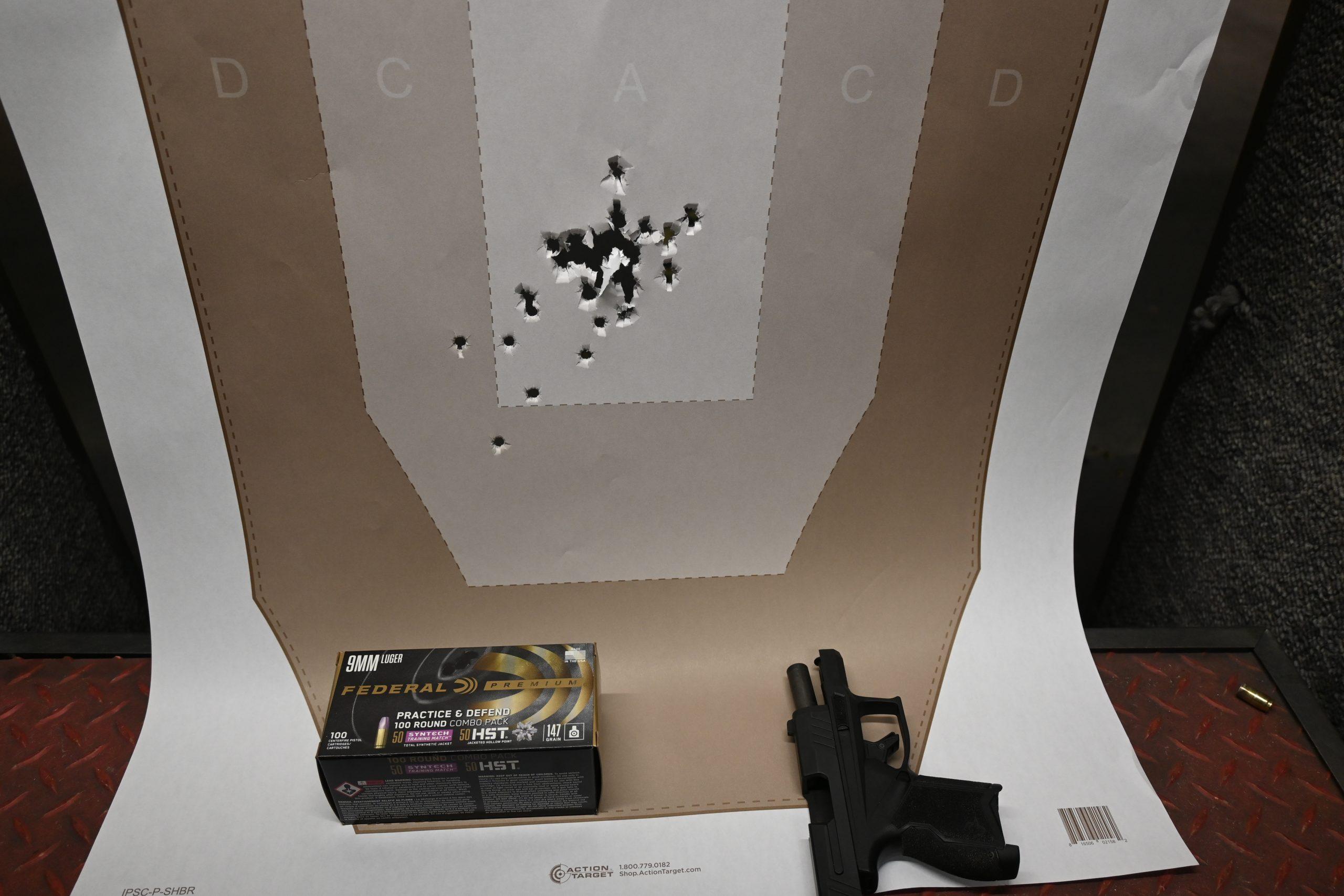
In my extended testing, the DB9 Gen 4 proved reliable with quality ammunition but picky with cheap bulk packs. I experienced 3-4 failures to feed across 800 rounds, all with bargain-basement ammunition. The EC9s, Shield Plus, and GX4 all ran everything I fed them without complaint.
My honest assessment: The DB9 fills a specific niche for users who prioritize ultimate concealability and light weight over capacity. At under 14 ounces loaded, it disappears in a pocket in ways the heavier competitors don’t.
But for $50-$80 more, the Taurus GX4 gives you 11+1 capacity in a package that’s barely heavier. Unless you’re specifically seeking the lightest possible 9mm, I’d spend the extra money for a GX4 or EC9s.
The AM2: Diamondback’s Most Competitive Offering
The AM2 double-stack 9mm is where Diamondback gets everything right.
AM2 vs. Glock 43X vs. Taurus GX4 XL
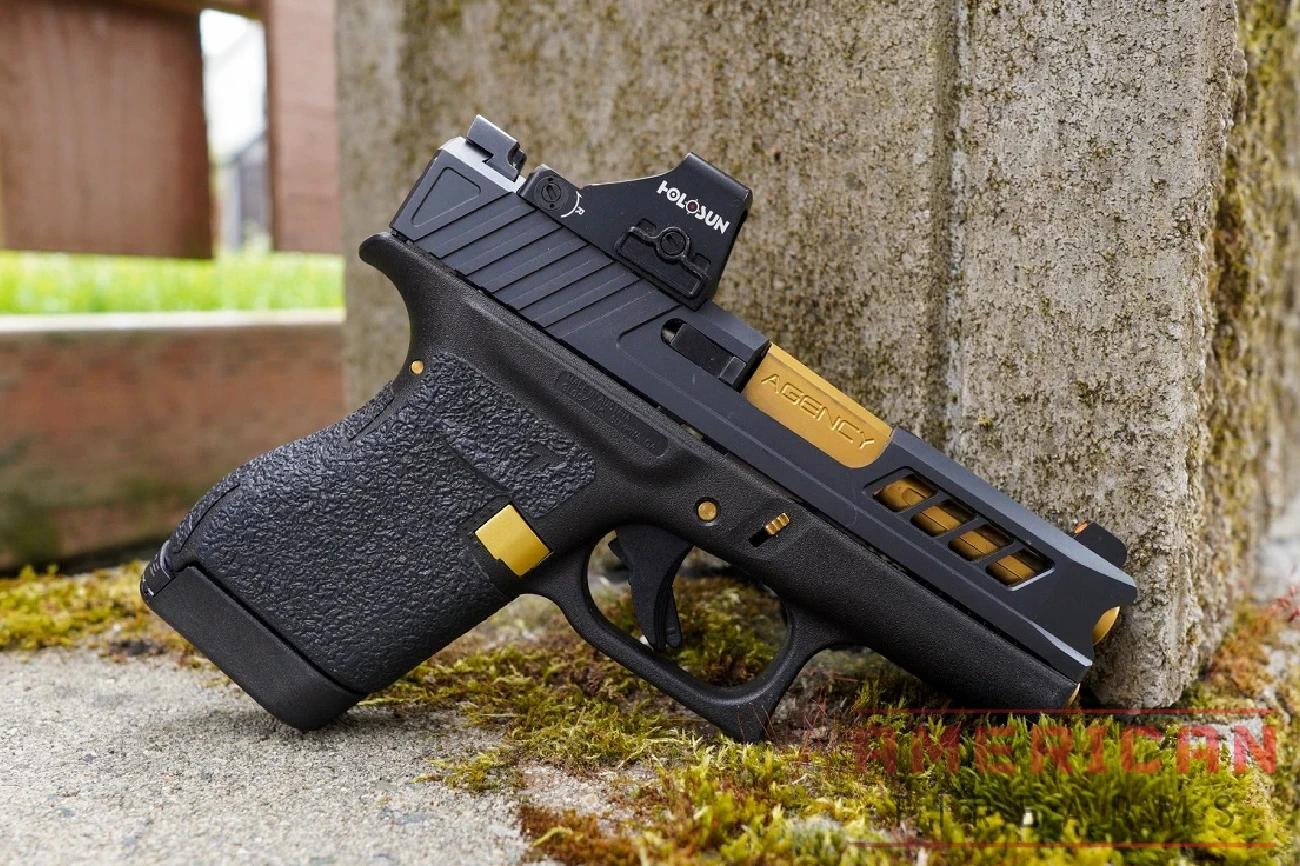
At $299 street price, the AM2 with 12+1 capacity directly challenges Glock’s 43X ($450-$500) and Taurus’s GX4 variants ($320-$370). I’ve put 1,200+ rounds through my AM2 test gun with zero malfunctions—matching the reliability of the Glock 43X that costs $150+ more.
The AM2’s Glock-pattern sights mean easy upgrades to Tritium or fiber optic options. The trigger is comparable to factory Glock triggers—not great, but serviceable and easily upgraded with aftermarket drop-ins. The 17+1 extended magazines transform the AM2 into a capable home defense gun for under $350 all-in.
- Where the AM2 wins: Price-to-performance ratio, aftermarket sight compatibility, grip texture, value
- Where competitors win: Glock 43X has better resale value and more holster options; Taurus GX4 XL has optics-ready variants
If I’m recommending a first carry gun to someone on a budget, the AM2 is my top pick. It delivers Glock-comparable reliability at half the price.
Unique Diamondback Advantages
After testing across the lineup, Diamondback excels in three specific areas:
- Machining Quality for the Price: Receiver fit on DB15 and DB10 models consistently exceeds PSA and Anderson. Tighter tolerances mean less rattling and better accuracy potential.
- Feature-Rich Mid-Tier Models: The Black Gold and Diamond series AR platforms include upgraded furniture, triggers, and finishes that would cost $200+ to add to competitor base models.
- American Manufacturing with Vertical Integration: Diamondback machines their own barrels, receivers, and rails in-house in Florida. Quality control is more consistent than brands outsourcing components.
Where Competitors Win
- PSA dominates on pure value and selection—their dozens of configuration options mean there’s a PSA for every niche.
- Ruger delivers unmatched reliability in the compact pistol market—the EC9s and LCP Max are genuinely more dependable than Diamondback’s DB9 and DB380.
- Aero Precision offers tighter AR-10 tolerances and better accuracy for users willing to spend $200-$300 more.
Bottom Line Recommendations
Buy Diamondback if:
- You want the best machining quality in the sub-$800 AR market (DB15)
- You need ultimate lightweight carry in 9mm (DB9)
- You’re seeking budget .308 accuracy for hunting (DB10)
- You want maximum features per dollar (AM2)
Buy Competitors if:
- You need absolute rock-solid reliability for defensive carry (Ruger EC9s, Glock)
- You want the cheapest possible entry to AR ownership (Anderson)
- You need match-grade precision from an AR-10 (Aero Precision)
- You prioritize maximum capacity in compact carry guns (Shield Plus, GX4)
The smart approach is knowing what you’re optimizing for. Diamondback’s firearms aren’t the absolute best in any category, but they deliver exceptional value when you weight reliability, features, and price together.
I keep an AM2 in rotation and genuinely recommend DB15s to new AR buyers—because they work, they’re well-made, and they don’t break the bank.
Who is Diamondback?
Starting in 1989, “with a small shop of three employees” Diamondback only entered the firearms business after evolving through other unrelated industries.
Originally a maker of boat accessories (Diamondback Marine), a no-doubt booming market in South Florida, then of fanboats (Diamondback Airboats), another staple of the Sunshine State, by 2009 the company added Diamondback Firearms to the mix.
Their first gun was the simple black-on-black micro compact DB380 in .380 ACP, expanding to a slightly larger 9mm DB9 by 2011, then the even larger 17+1 capacity AM2 pistol.
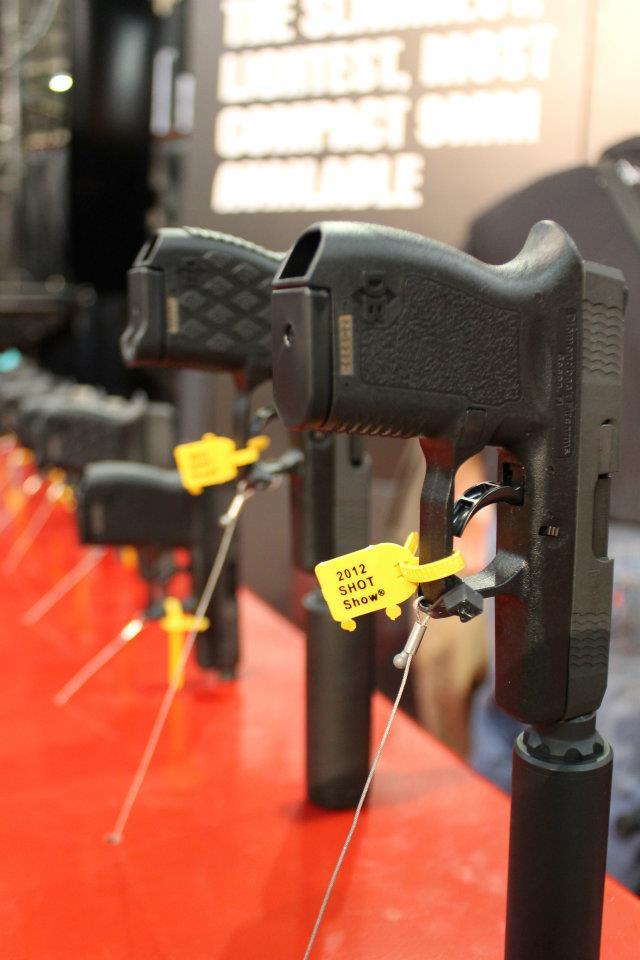
By 2013, the company had begun down the road to making AR-15 style rifles, then going into the more niche AR-10 market two years later. In 2018, they added a mutant 7.62×39 caliber AR to their catalog, followed shortly after by the very curious– and unique– DBX57 pistol then, last year, the Sidekick revolver, something that was unexpected.
Meanwhile, the Diamondback brand has expanded to include Diamondback CNC, Diamondback Barrels, and Diamondback Industrial Finishes– taking their in-house gun-making expertise to the next level by making components for other folks to put their name on.
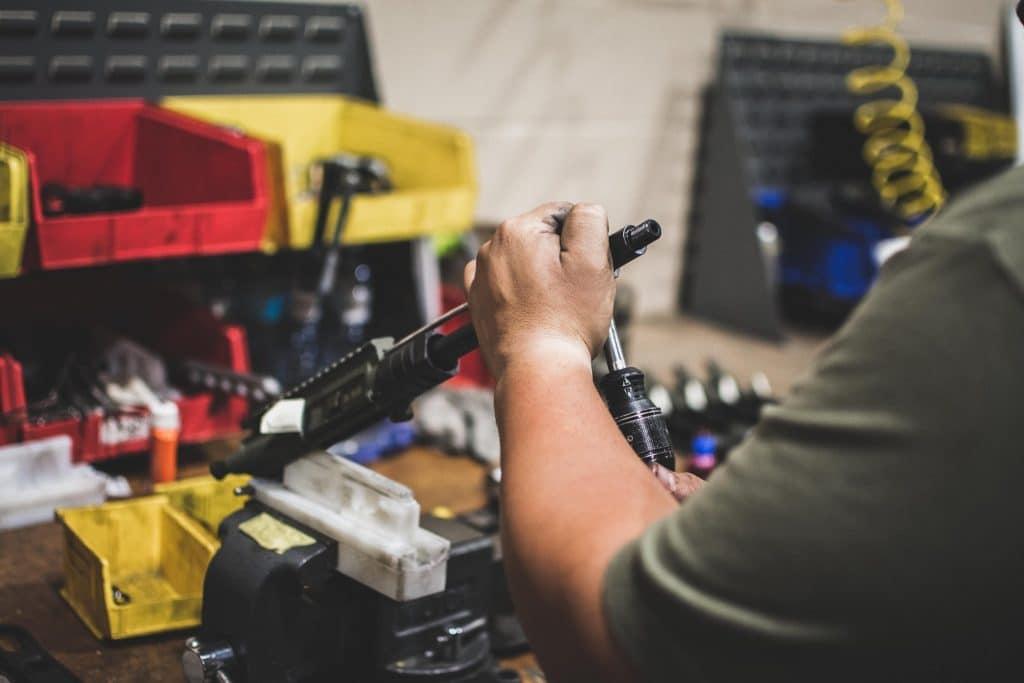
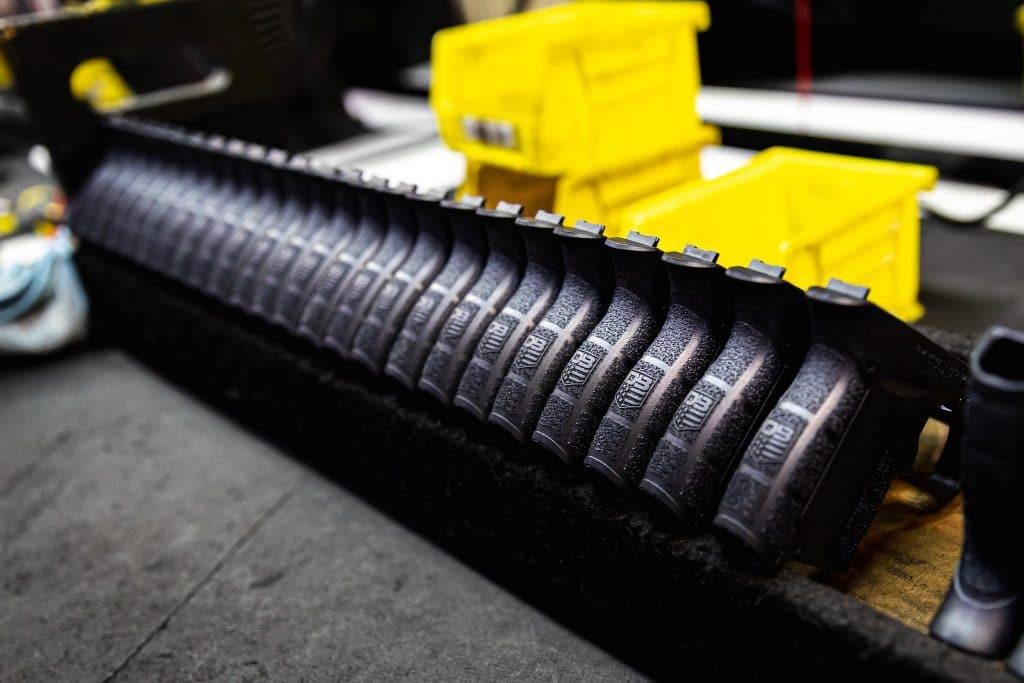
They also bought a knife company (Zac Brown’s Southern Grind knives) and have expanded their factories in Cocoa, Florida, on the Space Coast, a hub for engineers and high-tech manufacturing.
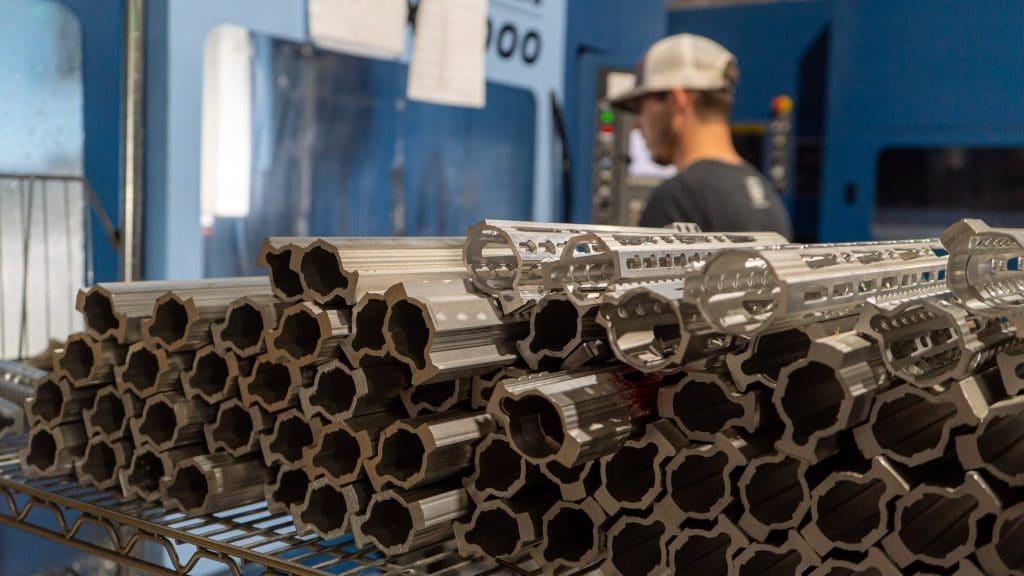
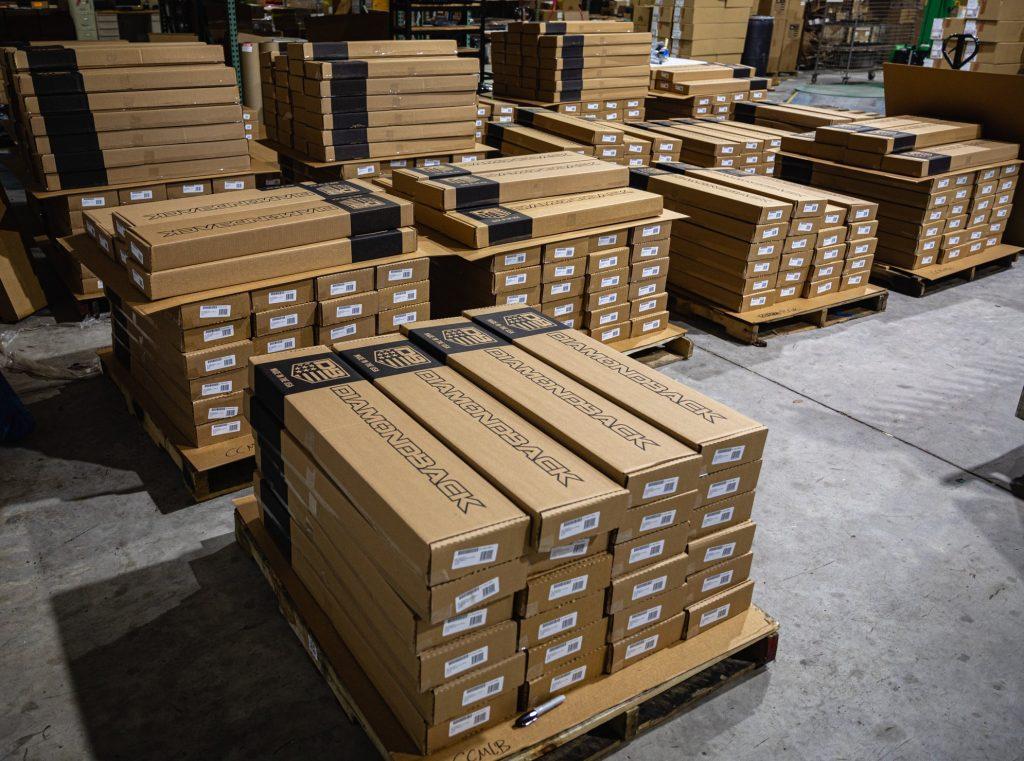
For a window on how their production has ramped up over the years, according to data from the ATF the company made just 1,526 firearms in 2009– all .380 pistols. In 2014, just five years later, Diamondback manufactured 42,901 pistols and 9,892 rifles. According to the most recent figures available, the company in 2019 produced a whopping 61,071 rifles along with 16,119 pistols and was listed as an international exporter as well, sending more than 3,000 of their firearms to hungry buyers overseas.
To put this in perspective, Daniel Defense in the same year only produced 26,094 rifles while Walther made 9,830 pistols in the U.S.
To say that Diamondback’s growth has been exponential is an understatement.
Aftermarket support
Nothing can be more aggravating than getting a firearm that is unsupportable, i.e., something for which you can’t find optics, triggers, holsters, magazines, and spare parts. When it comes to Diamondback Firearms, this isn’t a problem.
Large holster makers such as DeSantis and Galco have several fits for both the DB380 and DB9, although leather and Kydex for the less common AM2 may be harder to find.
The same story goes for magazines, with both Diamondback and aftermarket stick makers like ProMag producing inexpensive (sub-$25) magazines for the company’s handguns. As we have already covered, they accept Glock-pattern sights.
Diamondback’s rifles by and large are AR platforms, which makes them about as plug-and-play as possible.
The Never Ending Brace Issue
In 2012, SB Tactical, working in conjunction with Sig Sauer, introduced the modern pistol stabilizing brace.
This triggered a wave that swept through just about every AR maker in the past decade, with an estimated 3 million stabilizing braces since 2013– and that is the figure the ATF cites.
Well, in order to clarify when a pistol with a brace attached is actually a rifle “intended to be fired from the shoulder,” the U.S. Attorney General signed ATF proposed rule last year, “Factoring Criteria for Firearms with Attached ‘Stabilizing Braces,” proposing to amend the ATF’s regulations on the popular devices, splitting the hair between a legal pistol with a brace and an unregistered (and therefore illegal) SBR.
The final rule, ATF final rule 2021R-08F, was published in January 2023 and essentially ruled any AR pistol with a brace an SBR, causing chaos with pistol owners everywhere. In a quick about-face, as of late 2025 “Final Rule 2021R-08F was set aside nationwide and has not been enforced” — meaning we’re all free to run braces once again (for now.)
Are Diamondbacks any good?
While folks like to make lists of brands used by the “poors” in which they lump Diamondback in with PSA and Anderson, the guns made by this Florida-based manufacturer are well-tested and have received a lot of accolades by those that have used them.
Several law enforcement customers, especially in South Florida, run the company’s DB15s.
There are lots of stress-tests and torture tests out there on Diamondback firearms going back a decade and the guns just run after repeated mag dumps. Firearms writers for numerous publications and websites have– sometimes begrudgingly– given the company’s guns a nod when it comes to reliability and durability.
Diamondback uses FEA (finite element analysis) in their design process, are a leader in developing and applying corrosion-resistant coatings– remember, they have their own coating business– developed to protect metal in the tough Florida saltwater climate, and have been innovative, creating the “ZERO Energy” striker firing system used on the company’s AM2, DB380, and DB9 handguns, as well as the piston system used in the DBX57.
Check out the company’s in-depth quality control and testing process, done on every gun.
How long will a Diamondback last?
Diamondback, as shown in factory tours of the facility, is modern, filled with top-of-the-line CNC machines, robots, laser engravers, and remote manufacturing.
The company, unlike many competitors, makes just about everything for their guns in-house and believes in the little things like getting the stakes right on gas keys and castle nuts and constant QC with CMMs, optical comparators, and gauges to make sure every component stays in spec.
With that, you can expect a Diamondback AR to remain ticking as long or longer than any other standard mil-spec AR made in the U.S.
The company has a “Limited Lifetime Warranty” on all its firearms, which gives you a good idea of what they think of their build quality.
Carbon? Diamond? Black Gold? Billet?
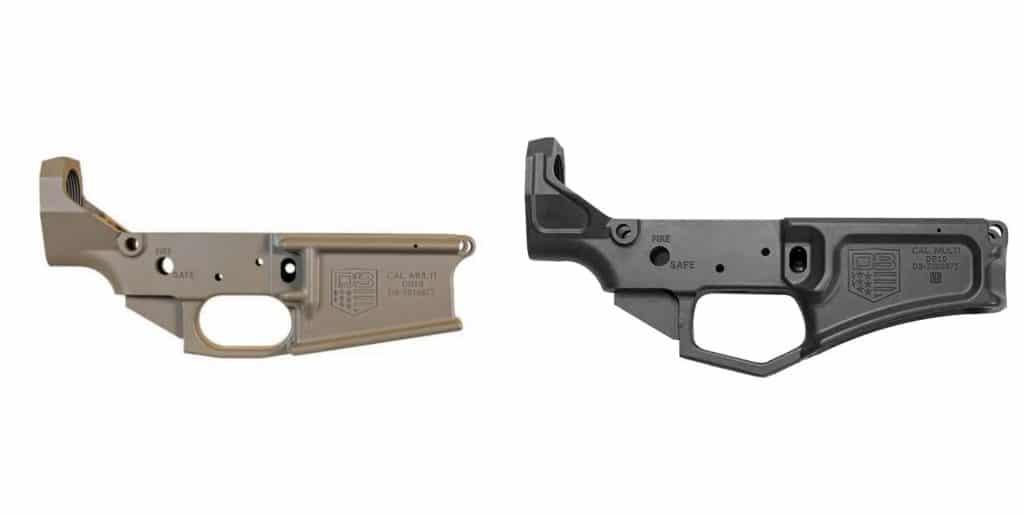
Diamondback, for most of its ARs, uses forged 7075 T6 Aluminum upper and lower receivers. They finish these in three different grades– Carbon Series, Black Gold Series, and Diamond Series. The basic Carbon models have a standard trigger guard while the progressively nicer Black Gold and Diamond models have enhanced trigger guards and more elaborate machining. The price range between the three grades is modest, for instance with the company only listing around a $65 difference when it comes to stripped lowers in Carbon and Diamond grades.
At this point, Diamondback also makes billet AR receiver sets, but only in the DB15 format, and only for separate sales.
Summary
Diamondback parachuted on to the firearm scene a little over a decade ago and has gone from being a complete unknown to being a household name– at least in the black rifle world.
The DB15 line is probably the best combination of quality and affordability you will find today, especially when you look at some of the more tricked-out models. It is really tough to seriously beat the platform for the price.
The same thing can be said about the DB10, with their .308 pistols being trendsetters in the field and a sleeper that folks should take a second look at. Then there are new guns that nobody else has a comparable version of, namely the DBX57 and Sidekick.
Our thought is that it is hard to go wrong with a Diamondback. Keep an eye on them, we certainly are.

Reviewed
December 27, 2025 — Added comprehensive “How We Test” section detailing 500-1,000+ round testing protocols. New “Diamondback vs. Competitors” section with head-to-head comparisons against PSA, Anderson, Ruger, and Smith & Wesson.
Sign up for our newsletter
Get discounts from top brands and our latest reviews!
View by Category

In-Hand Reviews

Firearm News

Featured Comparisons

Firearm & Ammo Reviews

Popular Guides & Stats

Range Gear & Accessories

Gun & Ammo Safes